Copper wire is often evaluated as an alternative to gold wire because it can reduce bonding-material cost while providing strong electrical and thermal performance. However, changing from gold to copper is not simply a matter of installing a different spool on the same wire bonder.
The wire material affects free-air-ball formation, capillary wear, bonding force, ultrasonic response, bond-pad stress, second-bond behavior, corrosion exposure and the qualification plan. A machine that has produced stable gold-wire packages may require different hardware, tooling, process control and package validation before it can run copper reliably.
The practical decision is therefore not whether copper is generally better than gold. It is whether the complete package, machine and production process can support copper without creating unacceptable yield, reliability or conversion costs.
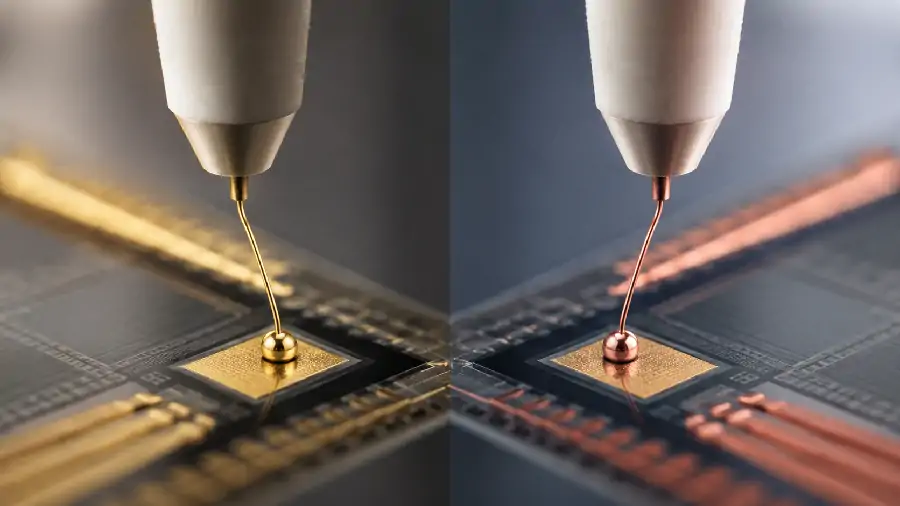
Copper and Gold Create Different Process Conditions
Gold has a long production history in semiconductor ball bonding. Its corrosion resistance, stable mechanical behavior and established process knowledge make it suitable for many fine-wire packages, especially where process maturity, sensitive pad structures or lower production volume are more important than minimizing wire-material cost.
Copper is attractive because of its lower material cost, electrical conductivity, thermal conductivity and mechanical strength. Those benefits come with a different manufacturing challenge. Copper is harder and stiffer than gold, oxidizes more readily and can place greater mechanical stress on the bond pad and underlying chip structure.
| Selection Area | Gold Wire | Copper-Based Wire | Conversion Consequence |
|---|---|---|---|
| Material cost | Higher exposure to precious-metal cost | Generally lower raw wire cost | Total savings must also include tooling, gas, qualification, yield and conversion work. |
| Electrical and thermal behavior | Suitable for established fine-wire semiconductor interconnects | Offers strong electrical and thermal performance | Material properties alone do not establish package-level performance. |
| Mechanical behavior | Softer and more forgiving during bond formation | Harder and stiffer than gold | Pad structure, force, ultrasonic energy and capillary design require closer review. |
| Oxidation | Highly resistant to oxidation and corrosion | Bare copper is more sensitive to oxidation | Free-air-ball formation and atmosphere control may need to change. |
| Tool wear | Established capillary materials and geometries | May produce greater capillary wear | Copper-optimized capillary material and geometry may improve stability and tool life. |
| Pad interaction | Generally provides a wider mechanical process window | Can increase pad stress and cratering risk | The aluminum pad, passivation opening and underlying structure must be evaluated. |
| Reliability direction | Mature field history across many package families | Can provide strong reliability when the package and process are properly qualified | Neither material should be declared universally more reliable without package-specific evidence. |
Palladium-coated copper and other coated-copper constructions can improve selected aspects of handling, oxidation resistance, bondability or corrosion performance. They should not be treated as identical to bare copper or to one another. The wire construction, coating, package materials and molding environment remain part of the qualification.
Can an Existing Gold Wire Bonder Run Copper?
Some automatic ball bonders are designed to support both gold and copper processes. That does not mean every machine carrying the same model name contains the hardware and software required for copper bonding.
The review should be tied to the exact machine configuration rather than to a general brochure statement.
| Equipment Area | What to Confirm | Why It Matters for Copper |
|---|---|---|
| Bond head and transducer | Installed head type, ultrasonic capability, force control and maintenance condition | The copper process may require a different operating window and more precise control of bond energy. |
| EFO system | EFO hardware, discharge control, electrode condition and copper-process support | Stable free-air-ball formation is essential to first-bond consistency. |
| Protective atmosphere | Gas-delivery hardware, nozzle arrangement, flow control and active machine options | Many copper ball-bonding processes use a controlled atmosphere around free-air-ball formation. |
| Capillary | Material, tip geometry, hole dimensions, surface condition and expected tool life | A capillary developed for gold wire may not provide the required copper bond formation or wear resistance. |
| Wire path | Spool, guides, tensioner, clamp and wire-feed condition | The harder wire may respond differently during feeding, looping and tail formation. |
| Workholder and heater | Package support, flatness, clamping and temperature control | Mechanical support and thermal stability affect pad stress and bond repeatability. |
| Software | Software release, copper-related options, parameter access and process-monitoring functions | Installed hardware may remain unusable when the necessary functions or licenses are missing. |
| Vision and process monitoring | Ball inspection, bond placement, pattern recognition and available monitoring functions | The conversion may require tighter control of ball shape, bond geometry and process variation. |
A machine listing that states “supports gold and copper wire” is only a starting point. The installed EFO, gas system, bond head, capillary, software and package-handling configuration still need to be matched to the proposed wire and product.
Available equipment directions can be reviewed through the Semimachine wire bonder category, but final compatibility must be confirmed against the exact machine and package process.
Free-Air-Ball Formation Changes First
In ball bonding, the first visible difference between gold and copper appears before the wire touches the bond pad. The EFO system melts the wire tip to create the free-air ball that will become the first bond.
Gold forms a free-air ball readily under established production conditions. Copper is more sensitive to oxidation during ball formation. An unsuitable EFO condition or atmosphere can produce an irregular ball, surface oxidation, poor centering or unstable neck geometry.
A copper conversion should therefore evaluate:
The selected wire construction and diameter
The EFO electrode and discharge condition
The protective-atmosphere arrangement where required
Free-air-ball diameter, shape, symmetry and surface condition
Ball position relative to the capillary
Heat-affected-zone and neck behavior
Stability over repeated ball-formation cycles
Passing one visual ball inspection is not enough. The process must remain stable through repeated operation, wire-spool changes and normal production variation.
Copper Changes the First-Bond Process Window
The harder copper ball can transfer more mechanical stress to an aluminum bond pad and the structures beneath it. This does not mean copper will always damage the pad, but it does mean the package and bonding parameters must be evaluated together.
The first-bond review should consider:
Aluminum pad thickness and metallization condition
Passivation opening and usable bond area
Underlying dielectric and circuit structures
Capillary tip and chamfer geometry
Bond force, ultrasonic energy and bonding time
Workholder temperature and package support
Ball deformation and bonded-ball diameter
Pad peeling, cratering or subsurface damage
Increasing force or ultrasonic energy should not be the automatic response to a weak copper bond. A poor result may also come from oxidation, contamination, unsuitable capillary geometry, unstable ball formation, weak package support or incompatible pad construction.
The correct process window must create sufficient interfacial bonding without causing unacceptable pad deformation or underlying damage.
The Capillary Is Part of the Conversion
The capillary controls ball deformation, wire movement, loop formation and the second bond. A tool that performs well with gold wire may not provide the required response, wear resistance or second-bond stability with copper.
Copper-focused capillary selection may involve changes to:
Ceramic material and wear resistance
Hole diameter and wire clearance
Chamfer diameter and angle
Tip diameter and face geometry
Outside radius
Tool length and package access
Surface finish and wire-gripping behavior
The correct geometry depends on the wire diameter, pad pitch, bonded-ball target, package access and required second-bond behavior. There is no universal “copper capillary” that fits every package.
Looping and the Second Bond Must Be Requalified
A conversion can produce an acceptable first bond while still failing at the loop or second bond. Copper’s stiffness changes how the wire responds to capillary movement, clamp action, tail control and package geometry.
Review the complete interconnect:
| Process Area | What to Observe | Possible Conversion Risk |
|---|---|---|
| Loop formation | Loop height, span, shape, clearance and consistency | Excessive stiffness may change the established gold-wire loop response. |
| Neck region | Neck profile, heat-affected-zone condition and break location | An unstable free-air ball or loop program may create neck weakness. |
| Second bond | Stitch shape, adhesion, deformation and failure mode | Leadframe finish, capillary geometry and wire gripping may require a new process window. |
| Tail formation | Tail length, consistency and readiness for the next EFO cycle | Clamp, tear and EFO behavior may not transfer directly from the gold-wire recipe. |
| Wire sweep and clearance | Position before and after molding or package movement | Loop stiffness and molding interaction may change the final wire position. |
The full loop program should be tested across central, edge, short-span, long-span and difficult-access bond locations where they exist in the package.
Package Materials Influence Long-Term Reliability
Wire reliability cannot be predicted from the wire material alone. The bond-pad metallization, leadframe or substrate finish, molding compound, package moisture exposure and operating environment all interact with the interconnect.
Copper can form mechanically robust bonds in suitable packages, but corrosion-related failure mechanisms require careful attention. Palladium coating may improve selected conditions, yet it does not remove the need to evaluate the package environment and material interfaces.
The conversion review should include:
Bond-pad and terminal metallization
Residual aluminum after ball bonding
Intermetallic development at the interface
Molding-compound chemistry and ionic contamination
Moisture and temperature exposure
Package delamination
Thermal cycling and coefficient-of-expansion differences
Application voltage, current and field environment
A successful initial bond test demonstrates only the tested condition. It does not replace package-level reliability qualification.
Build a Controlled Gold-to-Copper Conversion Plan
The strongest conversion approach separates material selection, machine readiness, process development and package qualification instead of changing all four at once without a defined baseline.
| Conversion Stage | Required Decision | Evidence to Produce |
|---|---|---|
| 1. Establish the gold-wire baseline | Define the current wire, capillary, package, machine configuration, bond results and reliability history. | Current recipe, material labels, bond images, pull or shear data, yield and known failure modes |
| 2. Select the copper direction | Compare bare copper, palladium-coated copper or another qualified construction. | Wire specification, coating information, spool format and supplier recommendations |
| 3. Confirm machine readiness | Verify EFO, atmosphere control, bond head, software, wire path, heater and monitoring functions. | Machine configuration record, option list, functional test and maintenance status |
| 4. Select the capillary and tooling | Match the capillary, workholder and wire-handling components to the copper process. | Tool drawing, package-clearance review and initial bonding trial |
| 5. Develop the process window | Establish stable ball formation, first bond, loop and second bond without unacceptable pad damage. | Bond geometry, visual inspection, process-window data and repeated-run results |
| 6. Verify mechanical performance | Measure the applicable pull, shear and failure modes against agreed criteria. | Test method, sample size, force result, failure location and cross-sectional evidence where required |
| 7. Qualify the package | Confirm reliability under the package’s actual environmental and operating requirements. | Applicable reliability-test results, failure analysis and qualification approval |
| 8. Validate production economics | Compare total conversion and operating cost rather than wire price alone. | Wire use, gas, capillary life, yield, downtime, qualification cost and production output |
This sequence is the central conversion decision. Copper should move into production only after the selected wire, exact machine configuration, capillary, package and qualification evidence have been evaluated as one connected process.
When Copper May Be the Better Direction
Copper may be worth qualifying when:
Gold-wire consumption creates a significant and recurring material cost.
The production volume can justify equipment, tooling and qualification work.
The bond-pad and package structure can support the required copper process window.
The machine contains or can economically receive the required copper-bonding configuration.
The package benefits from copper’s electrical, thermal or mechanical properties.
The manufacturer can control wire, gas, capillary and molding-material consistency.
Reliability can be demonstrated under the product’s actual application conditions.
Available wire specifications can be discussed through the copper bonding wire product page. The wire diameter, construction, spool format, bonder model and package requirement should be reviewed together.
When Retaining Gold May Be More Practical
Gold may remain the more reasonable production choice when:
The package already has a mature and reliable gold-wire process.
Production volume is too low to recover the full conversion cost.
The pad or underlying structure is sensitive to the mechanical copper process.
The available machine lacks the necessary EFO, atmosphere-control or software configuration.
Qualification effort would disrupt an established product or customer approval.
The package operates in an environment where the selected copper construction has not been adequately validated.
Yield loss, capillary wear or additional process controls would offset the material saving.
The correct conclusion may also differ between package families. A factory can qualify copper for high-volume products while retaining gold for lower-volume, sensitive or long-established devices.
Copper vs Gold Wire Bonding FAQ
Can gold wire be replaced with copper on the same wire bonder?
Possibly, but compatibility depends on the exact bonder configuration. Confirm the bond head, EFO, protective-atmosphere hardware, software options, capillary, wire path, workholder and package process before planning the conversion.
Can the same capillary be used for gold and copper wire?
It should not be assumed. Copper may require a different capillary material or geometry to manage wear, bonded-ball shape, pad stress, wire gripping and second-bond performance.
Is palladium-coated copper always better than bare copper?
No. Palladium coating may improve selected bonding, handling or corrosion conditions, but the result depends on the wire construction, package materials, process and reliability environment.
Does copper wire always reduce total production cost?
No. The economic result should include wire price, gas, capillaries, machine modification, qualification, downtime, yield, maintenance and reliability risk. Raw material savings do not automatically produce a lower total package cost.
Is a pull test enough to approve a copper conversion?
No. Pull or shear testing provides useful mechanical evidence, but complete approval may also require visual inspection, failure-mode review, cross-section analysis, repeated production trials and package-level reliability testing.
Final Recommendation
Copper wire can offer meaningful material, electrical and thermal advantages, but it should be treated as a package and process conversion rather than a direct replacement for gold. Confirm the exact wire construction, machine configuration, EFO and atmosphere control, capillary, pad structure, loop behavior and qualification requirements before making the change.
To review an equipment or bonding-material requirement, send the current wire specification, wire bonder model, package type, pad information and conversion objective through the Semimachine equipment inquiry page. The initial discussion can then focus on machine configuration, material availability and the technical areas that still require application qualification.