The K&S ICONN name appears frequently in semiconductor equipment listings, maintenance records and wire bonder sourcing requests. However, ICONN does not always identify one universal machine configuration. A listing may refer to an ICONN, ICONN PLUS, ICONN ProCu, ICONN ProCu PLUS, LA or ELA machine, and each name can point to a different equipment generation or material-handling arrangement.
Selecting the correct K&S ICONN wire bonder therefore requires more than matching the name shown in a quotation. The wire material, package dimensions, bondable area, indexer, clamp, heater block, software and process history must all be reviewed together.
This guide explains how the common ICONN model names are related, what each configuration is generally intended to address and which information should be confirmed before selecting a machine.
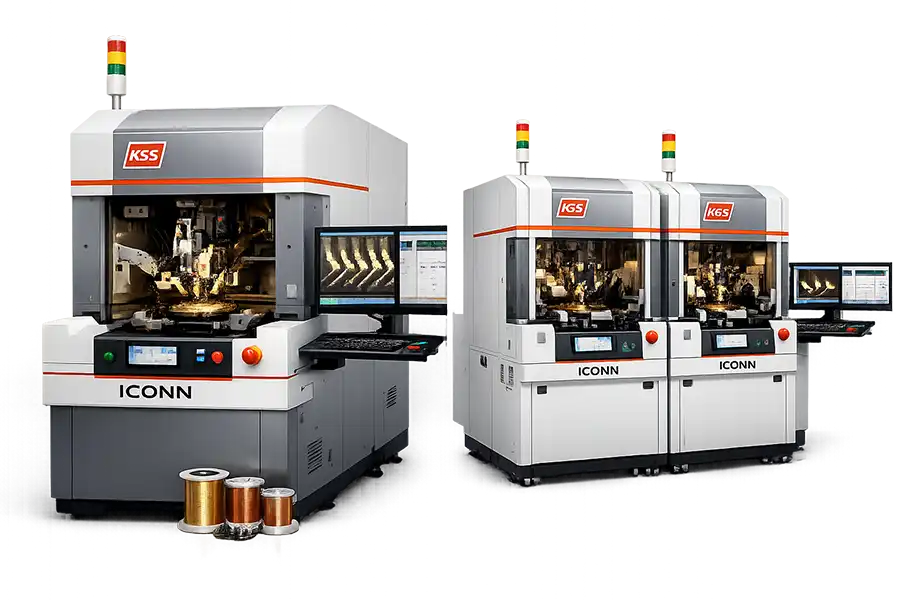
Is K&S ICONN a Single Wire Bonder Model?
K&S ICONN is best understood as a wire bonder platform or model family. Machines from this family are automatic thermosonic ball bonders used to form fine-wire electrical connections between semiconductor die pads and package terminals.
During ball bonding, a free-air ball is formed at the end of the wire. A ceramic capillary places the ball onto the die pad to create the first bond. The bond head then forms a programmed wire loop before completing the second bond on a leadframe, substrate or package terminal.
Different ICONN machines may have different wire-process packages, indexers, software versions, vision systems, bond heads and tooling. For that reason, two machines carrying the ICONN name may not be interchangeable for the same semiconductor package.
Common K&S ICONN Model Names
| Model Name | General Positioning | What Must Be Confirmed |
|---|---|---|
| K&S ICONN | General ICONN automatic ball wire bonder platform | Full model suffix, wire capability, year, software, indexer and tooling |
| K&S ICONN PLUS | Later ICONN platform designation for production ball bonding | Installed process package, bond head, EFO, vision and handling configuration |
| K&S ICONN ProCu | ICONN configuration developed around copper wire bonding requirements | Copper hardware, protective gas system, EFO, capillary and process history |
| K&S ICONN ProCu PLUS | Later copper bonding generation with upgraded process subsystems | Exact PLUS generation, process options, bondable area and machine condition |
| ProCu PLUS LA | Factory large-area configuration | Indexer range, clamp, heater block, package width and actual bondable area |
| ProCu PLUS ELA | Extended large-area machine or upgraded configuration | ELA identification, upgrade records, software, tooling and handling range |
K&S ICONN vs. ICONN PLUS
ICONN and ICONN PLUS are related platform names, but the word “PLUS” should not be treated as an insignificant label. It may identify a later equipment generation or a machine equipped with different process and productivity subsystems.
When comparing an ICONN with an ICONN PLUS, review the exact nameplate rather than relying only on the seller’s shortened product title. Useful comparison points include:
Complete model name and machine suffix
Manufacturing year and serial number
Bond-head and transducer configuration
Electronic flame-off system
Wire clamp and capillary interface
Vision hardware and lighting channels
Indexer and material-handling system
Software revision and active licenses
Available process files and backups
Included clamps, heater blocks and change parts
A newer platform name does not automatically mean that the machine is compatible with the customer’s package. A well-maintained machine with the correct indexer and tooling may be more useful than a later machine carrying unsuitable material-handling hardware.
K&S ICONN vs. ICONN ProCu
The main distinction between a general ICONN configuration and an ICONN ProCu configuration is the emphasis on copper wire bonding.
Copper wire bonding changes several parts of the process. Stable free-air-ball formation requires suitable EFO conditions and a controlled protective atmosphere. The capillary, ultrasonic parameters, bond force, pad structure and second-bond settings must also be matched to the copper wire.
Before describing an ICONN machine as a copper wire bonder, verify that the required copper-related systems are actually installed. Important points include:
Protective gas nozzles and gas-delivery components
Gas regulators, valves, tubing and flow control
EFO hardware and operating condition
Copper-compatible wire path and wire clamp
Suitable capillary holder and consumable specification
Software functions used by the copper process
Previous copper production or demonstration evidence
A machine may be physically capable of accepting copper wire but still require tooling, service, software or process-development work before it can run a qualified production package.
For a more detailed explanation of copper process requirements, review the K&S ICONN ProCu copper wire bonder guide.
ICONN ProCu vs. ProCu PLUS
ICONN ProCu and ICONN ProCu PLUS belong to the same copper wire bonding direction, but they should not be treated as the same machine generation.
ProCu PLUS was introduced as a later copper wire bonding platform with upgraded and enhanced subsystems. Published product information also distinguishes standard and large-area configurations. Earlier ProCu machines may use different hardware, software and process packages.
When comparing ProCu with ProCu PLUS, consider the following questions:
Does the machine nameplate specifically identify ProCu PLUS?
Which copper process generation is installed?
Is the machine a standard, LA or ELA configuration?
What is the verified bondable and handling area?
Which indexer, clamp and heater block are installed?
Are software licenses and process files included?
Can the seller provide a powered demonstration?
Has the machine previously run copper wire in production?
A general family brochure can explain the platform direction, but the practical capability of a used machine must be confirmed from its serial number and installed configuration.
Standard, LA and ELA ICONN Configurations
Standard, LA and ELA designations primarily matter when a package requires a wider bonding or material-handling range.
Standard Configuration
A standard ICONN or ProCu PLUS configuration may be suitable for conventional leadframes and substrates that fit the installed indexer, clamp and heater block.
LA Configuration
LA normally refers to a large-area configuration. It may provide a wider processing envelope, but the actual package compatibility still depends on the rail, transport system, clamp opening, heater block and bond locations.
ELA Configuration
ELA refers to an extended large-area configuration or upgrade route. The ELA name should be supported by machine documentation, nameplate information, software records or clear configuration evidence.
Do not select an LA or ELA machine from package width alone. The complete leadframe drawing should be checked, including:
Overall strip width
Matrix length and number of units
Rail geometry
Index direction and index pitch
Clamp contact area
Heater-block support area
First and last bond locations
Input and output handling requirements
Gold Wire or Copper Wire: Which ICONN Configuration Is Required?
Gold and copper ball bonding use a similar basic bonding sequence, but they do not have identical process requirements.
| Selection Point | Gold Wire Process | Copper Wire Process |
|---|---|---|
| Free-air-ball formation | Standard process conditions based on wire and EFO setup | Requires close control of oxidation, gas and EFO conditions |
| Protective gas | May not be required for every gold process | Commonly an important part of copper ball formation |
| Capillary | Selected for wire diameter, pitch and package geometry | Must also suit copper hardness and the target bonding window |
| Die pad interaction | Process developed for the selected pad structure | Requires careful force and ultrasonic control to protect the pad structure |
| Machine verification | Confirm gold-process hardware and previous operation | Confirm ProCu hardware, gas, EFO and copper-process evidence |
A machine configured for one wire material should not automatically be advertised as production-ready for another. Conversion may require consumables, gas hardware, software, service and complete process requalification.
How Package Design Affects ICONN Model Selection
The correct K&S ICONN machine is determined by the package as much as by the wire material.
Leadframe Packages
Confirm strip width, index pitch, rail geometry, heater-block contact, clamp design and bond locations. A machine can have sufficient XY travel but still be unable to transport or clamp the leadframe correctly.
Substrate-Based Packages
Review substrate dimensions, carrier requirements, warpage, heating method, alignment references and input/output handling.
Stacked-Die Packages
Stacked dies may require advanced loop profiles, additional capillary clearance, low-loop or high-loop control and carefully planned bonding sequences.
System-in-Package Applications
SiP structures can contain several dies and components with different heights. The selected machine must provide suitable vision, looping, access and program control for the complete assembly.
Large Matrix Packages
Large matrix formats may require LA or ELA material handling, but machine compatibility must be confirmed from the complete package drawing and actual installed tooling.
Information to Send Before Selecting an ICONN Wire Bonder
A useful machine inquiry should include as much of the following information as possible:
Target K&S model or existing production machine
Wire material, diameter and spool specification
Die dimensions and die-pad layout
Leadframe or substrate drawing
Package matrix dimensions
Required bondable area
Loop height and loop-profile requirements
First-bond and second-bond materials
Existing capillary specification
Required software or process files
Preferred machine year and condition
Destination country and installation requirements
When this information is unavailable, begin with clear photos of the current machine nameplate, package and tooling. These details can help identify the next configuration points that need confirmation.
Common Mistakes When Comparing ICONN Machines
Comparing Only the Model Name
The same model family can include different indexers, software versions, bond heads and process options.
Assuming Every ProCu Machine Is ProCu PLUS
Earlier ProCu equipment and ProCu PLUS equipment should be treated as different generations until the nameplate and configuration confirm otherwise.
Assuming Every Machine Supports Gold and Copper
Wire-material capability must be verified from the installed hardware, consumables, software and process history.
Ignoring Package Tooling
A machine without the correct clamp, heater block or change parts may require additional engineering before production can begin.
Using Advertised Speed as the Main Selection Criterion
Actual production output depends on the package, wire count, loop profile, index time, alignment, inspection and process stability.
Accepting a Dry Run as a Production Test
A dry run can demonstrate basic machine movement. It does not prove bond quality using the intended wire, capillary, package and recipe.
K&S ICONN Model Selection FAQ
Is ICONN the same as ICONN PLUS?
No. They are related K&S wire bonder platform names, but they may represent different generations or configurations. Confirm the complete nameplate and option list.
What does ProCu mean on a K&S wire bonder?
ProCu identifies a copper wire bonding process direction. The actual machine should include the required EFO, gas-delivery, software and process-related hardware.
What is the difference between ProCu and ProCu PLUS?
ProCu PLUS is a later copper bonding generation introduced with upgraded subsystems. Earlier ProCu machines should not automatically be described as ProCu PLUS.
What do LA and ELA mean?
LA generally means Large Area, while ELA means Extended Large Area. The actual handling and bonding range must be verified on the specific machine.
Can an ICONN copper wire bonder also run gold wire?
It may be technically possible on some configurations, but the installed hardware, capillary, EFO, software and process qualification must be reviewed before making that conclusion.
Which ICONN model is best for a large leadframe?
The choice depends on the full leadframe drawing, not only its width. Review the indexer, clamp, heater block, rail geometry and required bond locations.
Is a later ICONN model always the better choice?
Not necessarily. The most suitable machine is the one with the correct process, package handling, tooling, software and condition for the intended production requirement.
Where can I compare the wider ICONN series?
Review the K&S ICONN wire bonder series page for the main equipment-family overview and related model links.
Conclusion
K&S ICONN, ICONN PLUS, ICONN ProCu and ProCu PLUS are closely related search terms, but they should not be treated as identical machines. The correct selection depends on the wire material, package design, bondable area, material handling, software, tooling and condition of the actual equipment.
Start with the complete machine nameplate and package drawing. Then compare the EFO, gas system, bond head, indexer, clamp, heater block, software and operating evidence before confirming compatibility.
Explore the K&S ICONN model-family guide, review the ICONN ProCu copper wire bonder page, or browse additional semiconductor wire bonder machines.