A used MRSI-705 should be evaluated as one individual machine rather than as a generic example of the original platform. Two units with the same model name may differ in feeders, tool systems, process modules, vision hardware, software access and included tooling.
A marketplace listing or power-on video may establish initial interest, but it does not show whether the machine is correctly identified, complete or suitable for the intended assembly process. Platform documentation explains what an MRSI-705 may support; the equipment record and operating evidence show what the offered unit contains and can currently demonstrate.
A practical purchasing review should connect five evidence areas: machine identity, installed configuration, functional condition, process-relevant testing and delivery scope.
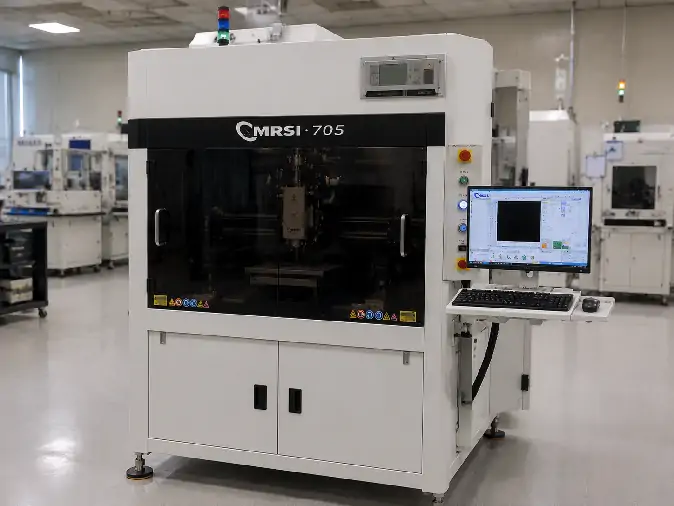
Confirm the Exact Machine Before Applying Specifications
Machine identity should be established before original specifications or seller claims are applied. A clear nameplate photograph provides stronger evidence than a listing title because it connects the manufacturer, exact model, serial number and electrical identity to the physical unit.
The initial record should include full-machine photographs, the nameplate, serial number, manufacturing year where recorded, current location and operating status. Maintenance documents, service history and information about the previous production process add useful context when they clearly refer to the same unit.
The distinction between the standard MRSI-705 and the MRSI-705HF is especially important. They are separate model variants, so high-force or top-side-heating values published for the HF version must not be assigned to a standard MRSI-705.
Previous application also helps define the inspection. Eutectic use may justify closer review of thermal hardware, dispensing history may direct attention to pumps and fluid paths, and wafer processing should be supported by evidence of the feeder, ejector, mapping functions and related tooling.
This history does not establish present condition, but it helps identify which records, photographs and demonstrations should exist.
Verify the Installed Configuration
Once the machine identity is clear, convert the seller’s option list into a machine-specific configuration record. Each claimed function should be supported by visible hardware, documentation, software recognition or a functional demonstration.
Material handling may include a wafer feeder and ejector, wafer-map or ink-dot workflow, waffle-pack or Gel-Pak presentation, tape-related equipment and standalone, in-line or cassette-based substrate transport. Work stages, fixtures, sector plates, trays and boats should also be identified because they determine how components and substrates enter the process.
Tooling needs equal attention. Photographs should show the installed tool bank or optional turret, nozzle heads, pickup collets, placement tools, stamping tools, heated tools and application-specific holders. The optional turret can hold up to 12 tools when fitted, but it is not standard on every MRSI-705.
Process modules may include flip-chip hardware, bottom-side vision, eutectic equipment, heated stages or bond heads, dispensing pumps, UV hardware or a thermal-compression arrangement. These functions should be attributed to the machine only when the relevant equipment and software are present.
A useful configuration record combines wide and close photographs, module images, build or option records, software screens and a labelled tooling inventory. Physical presence alone does not prove calibration, software access or process readiness: mounted hardware may be unavailable in software, and supplied nozzle heads may not include a suitable collet for the buyer’s component.
The buyer should first define the relevant MRSI-705 configuration requirements, then compare them with the physical and digital configuration of the offered unit.
Check Software, Access and Technical Records
A mechanically complete machine can still be commercially incomplete when software access, licenses or records are missing. These items affect whether the installed hardware can be configured, supported and commissioned after delivery.
Review the software version, operating-system condition, login access, passwords and active licenses. Process recipes, vision programs, wafer-map functions, tool definitions, calibration files and available backups should also be identified.
Existing recipes may not match the buyer’s component, but they can show that related modules were previously configured and may provide a useful engineering reference. Calibration files and historical records become more valuable when they can be compared with current machine behavior.
Manuals, service reports, maintenance history and replacement-part records help explain how the equipment reached its present condition. Older machines may introduce uncertainty around software upgrades, spare parts and manufacturer support, so availability should be investigated rather than assumed.
Licenses and programs may be tied to the machine, controller or a contractual arrangement. Their continued use or transfer should be supported by documentation.
Inspect the Systems That Create Placement and Bonding Performance
Exterior appearance and complete-looking hardware do not establish the condition of the systems responsible for placement and bonding performance. Controlled operation should demonstrate motion, position feedback, force response, vision behavior and the claimed process modules.
Axis homing and repeated movement can show whether the motion system completes basic commands consistently. Relevant linear-motor axes, encoder feedback and the Z-axis system should be observed for recurring alarms, unstable homing, unusual noise or irregular movement.
Force control should be demonstrated when it matters to the intended process. The purpose is not to claim original platform performance, but to show that the installed force-control system responds and can be accessed under an agreed condition.
Cameras, optics and programmable lighting should be reviewed through real images and recognition behavior. Depending on the application, this may include component detection, orientation recognition and substrate-fiducial alignment.
Tool pickup and return should be demonstrated where a tool bank or turret is installed. Wafer projects may require feeder movement, ejector operation and coordination between physical positions and map data. Dispensing, heating, UV or flip-chip functions should be tested only when they form part of the offered configuration.
Understand What Each Evidence Level Proves
Used-equipment demonstrations vary considerably in value. A factory acceptance test, or FAT, is an agreed evaluation of defined functions. A dry cycle shows a motion sequence without meaningful process material, while a representative test combines relevant tools, samples and acceptance criteria.
| Evidence Level | What It Can Show | What It Does Not Prove |
|---|---|---|
| Power-on and boot | Electrical power, controller boot and basic screen access | Motion quality, vision performance, force control or usable process modules |
| Homing and basic movement | Axis response, homing sequence and selected machine movement | Placement accuracy, stable process execution or material handling |
| Dry cycle | Sequence execution, selected movements and basic module coordination | Deposit quality, thermal behavior, bond formation or product suitability |
| Module-specific test | Operation of a claimed feeder, vision function, dispenser, heater or tool system | Compatibility between all modules or success on the buyer’s process |
| Representative pick-and-place | Recognition, pickup, alignment, movement and placement using relevant tools and samples | Bond quality or full production performance when bonding is not included |
| Representative bonding FAT | Agreed process functions under relevant tooling, materials and acceptance criteria | Performance outside the defined scope or long-term production stability |
A listing with many photographs and several nozzle heads may appear complete, but verified identity, documented options, software access, a defined tooling inventory and representative test evidence provide a much stronger basis for purchasing evaluation.
Power-on confirms limited electrical and controller response. Homing and dry-cycle evidence add information about motion and coordination, but they do not show material behavior, thermal stability, deposit quality or bonding results.
Module demonstrations become useful when they directly support the seller’s claims. A dispenser should be demonstrated as a working dispensing system. A wafer-processing claim should connect the feeder, ejector, software and handling sequence. Flip-chip evidence should include the relevant orientation, vision, tooling and process route.
Define the FAT Before Inspection or Payment
The FAT scope should be agreed before travel, deposit payment, final quotation acceptance, machine dismantling or packing. Otherwise, the buyer may expect a process demonstration while the seller has prepared only a power-on sequence.
The agreed scope should define the machine functions to be shown, the tooling and samples to be used, the acceptance criteria, the evidence to be recorded and any functions that cannot be evaluated.
A practical FAT may cover machine identity, installed options, software access, axis and vision operation, tool-bank or turret behavior and the process modules relevant to the purchase. Depending on the project, that may include wafer handling, dispensing, heating, UV, flip-chip functions, force response or representative component pick-and-place.
Remote document and image review is the lowest-cost first step. A live remote demonstration gives the buyer more control over what is shown, while an on-site inspection permits closer review of condition, tooling and records. A representative sample test provides stronger process evidence when suitable tooling, materials and machine access are available.
The required depth follows the transaction value, technical risk and cost of unresolved uncertainty. When representative testing is unavailable, that limitation should remain visible in the purchasing decision.
Separate Machine Condition From Refurbishment Claims
Used, inspected, repaired, refurbished and process-tested describe different evidence levels.
Used means that the machine has had previous ownership or operation; it says nothing about present functional condition. Inspected should identify what was reviewed, when the inspection occurred, who performed it and what remained outside the scope.
Refurbished should be supported by a documented work record covering cleaning, repairs, replaced parts, module service, calibration, software work and final testing. Refurbishment can range from cosmetic preparation to substantial mechanical and electrical work, so the label alone has limited technical value.
Confirm Delivery Scope and Commissioning Gaps
A machine can pass an agreed functional test and still arrive commercially incomplete. The final delivery list should identify the machine, installed modules, tool bank or turret, pickup and bonding tools, collets, stamping tools, sector plates, stages, fixtures, trays and boats.
Wafer-processing equipment may require feeder and ejector parts. Dispensing configurations may need pumps, cables, fluid-path components and accessories. Computers, controllers, software media, license evidence, passwords, backups and calibration files should also be listed explicitly.
Multiple nozzle heads do not establish that suitable tools for the buyer’s component are included. Original tooling may relate only to the former product, while missing fixtures or conversion parts can delay commissioning even when the main machine operates.
The delivery record should identify spare parts, removed items, utility documentation and exclusions. Packing photographs and a final accessory inventory can reduce disagreement after shipment.
Export packing, installation, training, warranty and technical support should appear only when confirmed in writing. Replacement tooling, software upgrades and manufacturer support should not be assumed.
<!-- Image: used-mrsi-705-tooling-and-delivery-scope.webp -->
Decide Whether to Stop, Request Evidence, Inspect or Quote
The next commercial step should reflect the remaining risk.
Pause the evaluation when machine identity is unclear, major options cannot be documented, software access is unavailable, delivery scope remains undefined or the test evidence conflicts with the seller’s description.
Request additional records when the configuration appears relevant but important module photographs, software screens or tooling information are missing. Arrange remote or on-site inspection when the equipment value and technical risk justify deeper verification. Define a representative FAT when process suitability is critical and suitable tooling, samples and acceptance criteria are available.
A qualified quotation becomes useful only after the identity, installed configuration, evidence level, missing items and delivery scope are sufficiently clear.
To review specific used MRSI-705 equipment, contact the technical team by email or WhatsApp with the machine listing, nameplate, seller option record, tooling information, target component and substrate, input format, bonding method and desired FAT scope.
Machine photographs, software screens, tooling images, drawings and process documents can be attached after the conversation is opened. Availability, inspection, representative testing, conversion feasibility, price, warranty and delivery should be discussed after the actual machine and project have been reviewed.
Frequently Asked Questions About a Used MRSI-705
What should be checked before buying a used MRSI-705?
Review the exact machine identity, installed configuration, functional condition, software access, tooling, process-relevant test evidence and complete delivery scope.
How can the configuration of a used MRSI-705 be verified?
Use nameplate and work-area photographs, option records, software screens, tooling inventories and functional demonstrations. The evidence should refer to the same physical machine.
Is a power-on video enough to evaluate an MRSI-705?
No. It may confirm electrical power, controller boot and limited access, but it does not establish motion quality, vision alignment, force response, tooling completeness or process capability.
Does every MRSI-705 include the 12-tool turret?
No. The turret is optional and should only be attributed to a machine when it is visible, documented or demonstrated.
What should an MRSI-705 FAT demonstrate?
The FAT should address the machine’s claimed modules and the buyer’s main process risks using suitable tooling, conditions and defined acceptance criteria. Untested functions should be recorded clearly.
What does refurbished mean for a used MRSI-705?
The term is meaningful only when supported by a documented work scope covering repairs or replacements, calibration, software work and final test evidence.
Conclusion: A used MRSI-705 must be evaluated as an individual machine because original platform specifications do not establish the configuration or present performance of a particular unit. Identity, installed hardware, software access, tooling, functional condition, process evidence and delivery completeness form one purchasing decision. Power-on and dry-cycle demonstrations provide limited evidence, while a properly defined FAT can address the claimed modules and the buyer’s real process risk. The next commercial step should follow the quality of the available evidence rather than the listing description or purchase price alone.