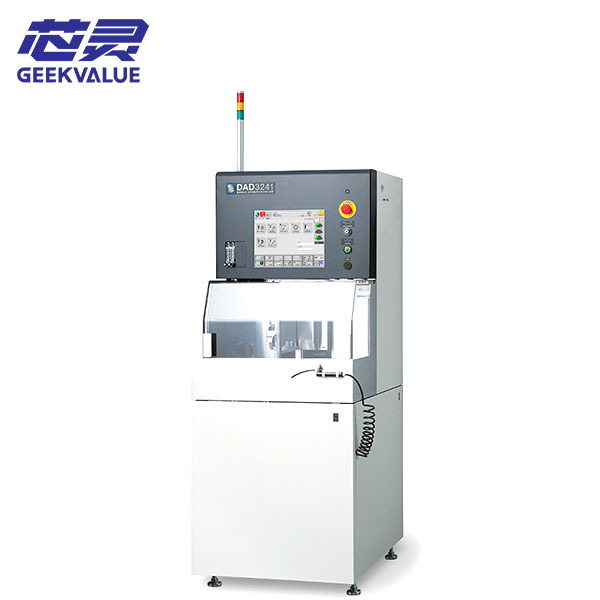
The DISCO DAD323 is a compact automatic dicing saw used for cutting compatible semiconductor wafers, electronic components, glass, ceramics and other materials. It uses a single spindle and supports workpieces up to 6 inches, while square workpieces require the applicable machine specification and holding setup.
For an initial inquiry, send your current dicing-saw model, clear photos of the wafer or workpiece and a short description of the required cutting process or current machine problem. Detailed blade, street and material information can be reviewed later when necessary.
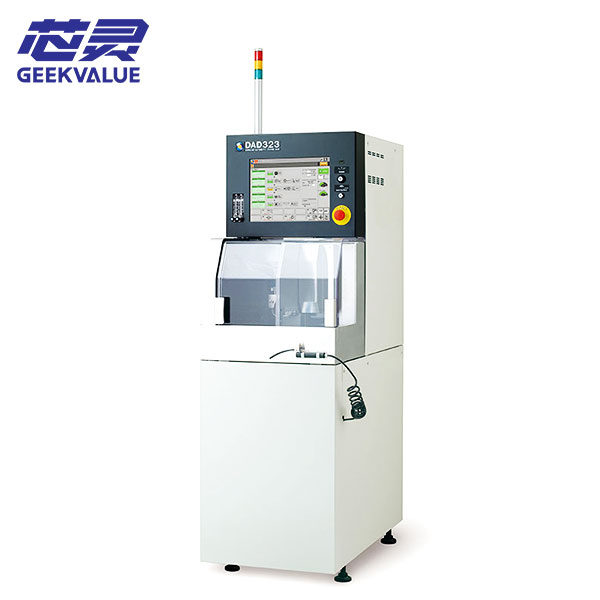
DISCO DAD323 Machine Information
| Manufacturer | DISCO |
|---|---|
| Model | DAD323 |
| Equipment Type | Automatic single-spindle dicing saw |
| Maximum Workpiece Size | Up to Φ6 inches; 150 × 150 mm square workpieces require the applicable user-specified configuration |
| X-Axis Cutting Range | 160 mm |
| Y-Axis Cutting Range | 162 mm |
| Standard Spindle | 2.0 kW at 40,000 min⁻¹ |
| Standard Spindle Speed | 3,000–40,000 min⁻¹ |
| Optional Spindle | 1.8 kW high-speed spindle with a maximum speed of 60,000 min⁻¹ |
| Alignment | Automatic alignment included in the manufacturer’s standard model specification |
| Machine Dimensions | Approximately 490 × 870 × 1,600 mm |
| Machine Weight | Approximately 400 kg |
| Production Status | Discontinued by the manufacturer; DAD324 is listed as the successor model |
| Condition | Pre-owned precision dicing equipment |
| Delivery Scope | Based on the quotation and confirmed equipment list |
| Shipping | Export packing and worldwide delivery |
Wafer and Workpiece Compatibility
The DAD323 model capacity does not automatically confirm that an available machine can cut every wafer or electronic component. Compatibility also depends on the material, workpiece dimensions, thickness, cutting street, required kerf, blade type, spindle configuration and holding method.
Only basic information is needed for the first discussion:
- Your current dicing-saw model if the DAD323 will replace existing equipment
- Clear photos of the wafer, substrate or electronic component
- A close-up photo of the cutting street or current cut result where available
- A short description of the required cutting process or existing problem
Detailed drawings, street dimensions, material data, blade specifications and cutting parameters can be reviewed later when the available machine appears relevant to the project.
Blade, Spindle and Cutting Setup
The standard DAD323 specification uses a 2.0 kW high-torque spindle, while a 1.8 kW high-speed spindle was available as an option. The spindle installed on a particular used machine should be confirmed before selecting blades or transferring an existing cutting process.
Cutting quality also depends on blade material, blade thickness, spindle condition, workpiece holding, cutting-water delivery, alignment and process settings. An existing blade or fixture should not be assumed to fit the available machine without checking the spindle, flange, table and workpiece setup.
Available DAD323 Configuration and Delivery Scope
Individual DISCO DAD323 machines may differ in spindle type, Y-axis scale option, worktable, wafer or component fixtures, alignment setup, cutting-water equipment, transformer, software and external utility accessories. Before purchase, the available machine should be reviewed to confirm whether its actual spindle, table and workpiece-handling configuration is suitable for the intended material and cutting process. The final delivery scope is based only on the quotation and confirmed equipment list; blades, flanges, fixtures, wafer frames, chillers, water-treatment equipment, transformers, computers and external utility systems are included only when specifically stated.
Receiving, Startup and Initial Cutting Trial
The DAD323 should be inspected and tested in stages before valuable production workpieces are introduced.
- Inspect the packing, machine cabinet, spindle area, worktable, control panel, microscope and visible utility connections.
- Photograph any impact marks, loose components, damaged cables or displaced assemblies before moving the machine.
- Compare the received machine, blade flanges, fixtures, pumps and accessories with the confirmed delivery list.
- Check that the spindle, worktable, microscope and motion axes remain secured after transportation.
- Confirm the electrical supply, grounding, compressed air, vacuum, cutting water, cooling and drainage requirements.
- Start the controller and record all alarm messages before resetting the machine or changing parameters.
- Check spindle rotation, table movement, alignment, water flow and related safety functions without a production workpiece.
- After basic operation is stable, use a suitable blade and non-production sample for an initial cutting trial.
Inspect the cut before increasing speed or depth. Repeat several cuts to check consistency, and stop testing if spindle vibration, abnormal noise, unstable alignment, water-flow problems or repeated alarms occur.
Cut Quality, Machine Alarms and Parts Support
Chipping, blade marks, excessive kerf, incomplete cutting or unstable cut depth may involve blade selection, spindle runout, workpiece holding, alignment, feed speed, cutting depth or cutting-water conditions.
Position errors may also involve the worktable, microscope calibration, theta alignment, encoder feedback or incorrect product data. The cut result and machine condition should be reviewed together before process parameters are repeatedly changed.
Record the alarm message and the stage at which the problem occurs before resetting the machine. Photos of the blade, flange, workpiece, cut street, chuck table and alarm screen, together with a short operating video where available, can provide a practical starting point for review.
Our team can assist with initial fault analysis, blade and component identification, replacement-part matching and repair discussion. Related spindles, motors, drivers, boards, sensors, cameras, cables, valves, pumps, water-system parts and motion components can also be checked where available. Because the DAD323 has been discontinued, the availability of specific replacement parts should be confirmed before purchase or repair.
Frequently Asked Questions
Can the DISCO DAD323 cut our wafer or electronic component?
This depends on the material, workpiece size, thickness, cutting street, blade, spindle and holding configuration. Send workpiece and current cut-result photos for an initial review.
Does every DAD323 have the 60,000 min⁻¹ spindle?
No. The high-speed 1.8 kW spindle was an optional configuration. The standard model specification uses a 2.0 kW spindle with a speed range of 3,000–40,000 min⁻¹.
Can the DAD323 process 6-inch square workpieces?
The manufacturer lists 150 × 150 mm square workpieces as a user-specified configuration. The table, fixture and handling setup of the available machine must therefore be confirmed.
Are blades, flanges and workpiece fixtures included?
Only blades, flanges, fixtures and related accessories listed in the quotation or confirmed delivery scope are included.
Can you assist with spindle alarms or poor cutting results?
Yes. Send the machine model, alarm information, blade and flange photos, close-up images of the cut and an operating video where available. We can assist with initial fault review, parts matching and repair discussion.
Contact Us About the DISCO DAD323
Send your current dicing-saw model, wafer or workpiece photos and a short description of the required cutting process or equipment problem. We will review the basic application first and continue with the necessary blade, spindle, fixture, replacement-parts or repair details afterward.