How much does a die bonder machine cost? The short answer is that a die bonder may cost from under USD 10,000 for an older manual or refurbished benchtop machine to several million dollars for a new, fully automatic production system used in high-volume or advanced semiconductor packaging.
That range is wide because “die bonder” can describe very different equipment. A manual machine used in a laboratory is not comparable to a fully automatic die attach system with wafer handling, epoxy dispensing, pattern recognition, post-bond inspection, and factory automation.
Machine condition, placement accuracy, throughput, bonding process, installed options, application, and after-sales support can all substantially affect the final price.
This guide explains the main die bonder price ranges, what determines the quotation, how new and used equipment compare, and what information buyers should prepare before requesting a quote.
Key Takeaways
A used manual die bonder may be available for less than USD 10,000, while advanced automatic systems can cost hundreds of thousands or several million dollars.
The model name alone is not enough to determine price. Year, configuration, condition, software, tooling, and process capability must also be checked.
Used equipment can reduce the initial investment, but inspection, refurbishment, installation, and missing parts must be included in the budget.
Placement accuracy and advertised UPH should be evaluated using the buyer’s actual die, wafer, substrate, lead frame, and bonding material.
The lowest purchase price does not necessarily produce the lowest cost per bonded die.
Die Bonder Machine Price at a Glance
The following figures are broad planning ranges rather than fixed offers.
| Die bonder category | Indicative price range | Typical application |
|---|---|---|
| Used manual or benchtop die bonder | USD 8,000–75,000 | Research, prototyping, repair, low-volume assembly |
| Semi-automatic or precision R&D bonder | USD 50,000–250,000 | Process development, MEMS, photonics, specialized packaging |
| Used automatic production die bonder | USD 50,000–500,000+ | Established IC, LED, sensor, and discrete-device processes |
| New automatic production die bonder | USD 250,000–3 million+ | High-volume semiconductor backend production |
| Advanced flip chip or thermo-compression system | USD 500,000 to several million | Fine-pitch, chiplet, 2.5D/3D, and advanced packaging |
These ranges overlap because a well-equipped refurbished precision bonder may cost more than an entry-level new machine. Likewise, a used automatic system supplied with inspection, refurbishment, tooling, installation, and warranty may cost more than the same model sold “as is.”
Public marketplace listings illustrate the lower end of the market. For example, refurbished manual and precision bonders have been advertised from approximately USD 8,900 to USD 68,500. However, most automatic semiconductor production systems are listed as “request price” because the final quotation depends on the individual machine.
Always request a configuration-specific quotation before establishing a project budget.
What Is a Die Bonder?
A die bonder, also called a die attach machine, picks an individual semiconductor die from a wafer, tray, waffle pack, or other carrier and places it onto a lead frame, substrate, package, interposer, or another die.
Depending on the process, the machine may also perform or support:
Epoxy dispensing or stamping
Die recognition and alignment
Wafer mapping
Ejector and collet control
Bond-force control
Heated-stage processing
Eutectic or solder die attach
Pre-bond and post-bond inspection
Lead-frame or substrate transport
Automatic loading and unloading
Production-data collection and MES communication
The required process determines which machine configuration is suitable—and therefore how much it costs.
Why Die Bonder Prices Vary So Much
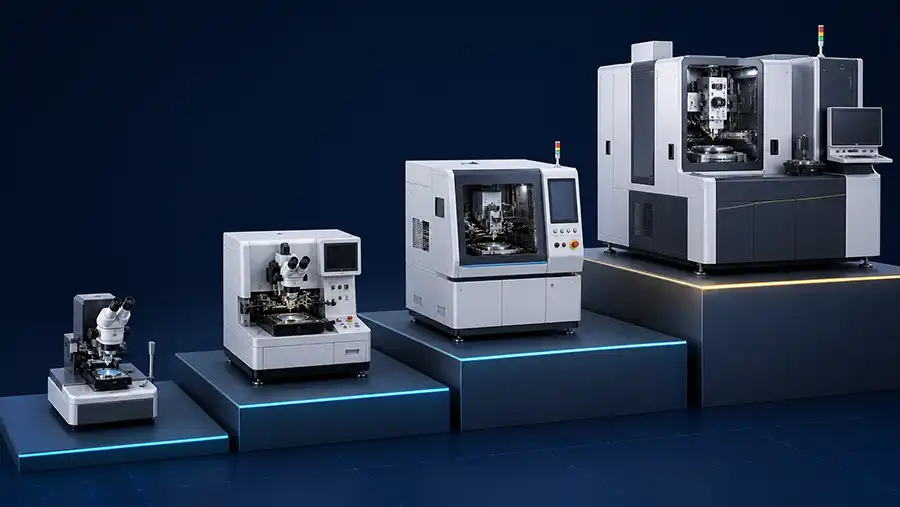
1. Manual, Semi-Automatic, or Fully Automatic Operation
Manual bonders depend heavily on the operator for alignment, pickup, placement, and process control. They are generally more affordable and may be suitable for research, prototyping, package development, and small production volumes.
Semi-automatic machines add motorized movement, programmable parameters, optical alignment, or controlled bonding functions. They offer better repeatability while retaining some operator involvement.
Fully automatic die bonders integrate material handling, vision alignment, die pickup, placement, inspection, and output handling. Their higher price reflects not only the bonding mechanism but also the complete production platform surrounding it.
2. Placement Accuracy and Repeatability
A machine designed for conventional lead-frame die attach may not need the same alignment capability as a bonder used for photonics, MEMS, micro-LED, flip chip, or fine-pitch advanced packaging.
As accuracy requirements move from tens of microns toward single-micron or sub-micron placement, the machine may require:
Higher-resolution cameras and optics
More stable machine frames
Linear motors and precision encoders
Thermal-drift compensation
Advanced pattern-recognition software
Closed-loop force and position control
More demanding calibration procedures
Buyers should evaluate both accuracy and repeatability. A headline accuracy value is of limited value if it cannot be sustained under real production conditions.
3. Production Throughput
An automatic die bonder capable of high units per hour requires fast wafer indexing, reliable die ejection, rapid vision recognition, stable material transport, and efficient input and output handling.
The real production rate depends on more than the bond head. It can also be affected by:
Die dimensions and thickness
Wafer quality and die spacing
Number of placements per substrate
Epoxy dispensing or stamping time
Vision-search requirements
Inspection settings
Product changeovers
Loading and unloading
Reject handling
Operator intervention and machine condition
For this reason, buyers should not compare machines using theoretical UPH alone.
4. Bonding Process
A straightforward epoxy die attach process usually requires less specialized hardware than eutectic, thermosonic, flip chip, or thermo-compression bonding.
Additional process requirements may include:
Controlled stage or bond-head heating
Forming gas or nitrogen
Programmable bond-force profiles
Flux or epoxy dipping
Solder preform handling
Die rotation or flipping
Upward- and downward-looking cameras
Active force feedback
Warpage compensation
Controlled-atmosphere chambers
Each added process module affects both the initial machine price and future maintenance costs.
5. Die and Substrate Handling
The quotation must reflect how materials enter and leave the machine.
Typical die input formats include:
Wafer frames
Waffle packs
Gel packs
Trays
Tape-and-reel
Bulk or custom carriers
Output materials may include lead frames, ceramic substrates, printed circuit boards, trays, strips, panels, or interposers.
Automatic wafer loaders, magazine handlers, substrate conveyors, barcode readers, and custom carriers can add substantially to the project price.
6. New, Used, or Refurbished Condition
A new machine normally offers the latest hardware, software, warranty, and manufacturer support. It also requires the largest initial capital investment.
A used machine may offer a much lower entry cost, especially when the buyer already operates the same model and has trained technicians, recipes, tooling, and spare parts.
However, the term “used” can describe several different supply conditions:
As is, where is
Deinstalled but not tested
Powered on and function checked
Inspected
Partially refurbished
Fully refurbished and calibrated
Refurbished with installation and warranty
These conditions should never be treated as equivalent when comparing prices.
New vs. Used Die Bonder: Which Offers Better Value?
The right decision depends on the application, production risk, internal engineering capability, and available budget.
A New Die Bonder May Be Better When:
The process requires the latest accuracy or automation
The package is still under development
Full OEM warranty is essential
Long-term software support is required
The equipment will become a critical production bottleneck
Factory integration and traceability must be developed from the beginning
A Used or Refurbished Die Bonder May Be Better When:
The process already runs on the same machine family
The factory needs additional capacity quickly
A legacy product must remain in production
The technical team understands the platform
Spare parts and service are still available
A lower initial investment is more important than having the latest model
A used machine should be selected by its actual configuration and condition—not by model number or exterior appearance alone.
What Should Be Inspected on a Used Die Bonder?
Before purchasing used die bonding equipment, inspect the systems that directly influence placement quality, process stability, and uptime.
Mechanical System
Check:
X, Y, Z, and theta-axis movement
Linear motors, guides, encoders, and bearings
Bond-arm condition
Abnormal noise or vibration
Signs of previous tool collisions
Cable chains, tubing, and pneumatic components
Wafer and Die Pickup System
Check:
Wafer table and expansion mechanism
Ejector pin and holder
Collet and collet adapter
Vacuum stability
Pickup-height repeatability
Missing-die detection
Compatibility with the intended wafer-frame size
Vision and Alignment System
Check:
Camera condition
Optics and lighting
Pattern-recognition stability
Calibration data
Pre-bond and post-bond inspection
Availability of required software functions
Material Handling
Confirm:
Input and output magazine type
Lead-frame or substrate dimensions
Loader and unloader operation
Conveyor and indexer condition
Sensors and barcode functions
Available change parts and product tooling
Epoxy or Bonding Module
Confirm whether the machine includes:
Dispenser or stamping assemblies
Syringe and needle hardware
Epoxy trays and stamping tools
Pressure controls
Heating modules
Required motors, sensors, and cables
Activated software options
A low-price machine can become an expensive project if essential modules or change parts are missing.
Costs Beyond the Machine Purchase Price
The equipment price is only one part of the total investment. Buyers should calculate the installed and production-ready cost.
Inspection and Refurbishment
A used machine may require:
Deep cleaning
Replacement of worn mechanical parts
New belts, tubing, seals, sensors, or cables
Camera or lighting replacement
Axis calibration
Safety-system checks
Software and parameter restoration
Tooling and Change Parts
A die bonder may need application-specific:
Collets
Ejector pins
Wafer chucks
Lead-frame rails
Work holders
Clamps
Dispenser needles
Stamping tools
Trays or magazines
Packaging and International Shipping
Semiconductor equipment may require anti-static protection, moisture protection, vacuum packaging, secure wooden crating, shock monitoring, and specialist handling.
Freight costs depend on machine size, weight, origin, destination, delivery terms, and whether air or sea transport is used.
Import Costs
The landed cost may include:
Import duties
Local taxes
Customs brokerage
Port handling
Inland transport
Cargo insurance
Inspection or certification fees
These costs vary by destination country and should be confirmed locally.
Installation and Commissioning
The installation budget may include:
Engineer travel
Machine positioning and leveling
Utility connection
Power-on and initialization
Mechanical calibration
Vision calibration
Material-handling verification
Process setup
Operator and maintenance training
Factory Utilities
Before purchasing, confirm requirements for:
Electrical supply
Compressed air
Vacuum
Nitrogen or forming gas
Exhaust
Cooling water
Cleanroom conditions
Floor loading and available space
Spare Parts and Future Downtime
The financial impact of downtime can exceed the difference between two purchase quotations. Buyers should investigate spare-parts availability, remote support, local engineering capability, and likely replacement lead times.
Purchase Price vs. Total Cost of Ownership
A machine with a lower purchase price is not automatically the least expensive machine to operate.
A simple cost-per-good-die calculation is:
Cost per good die = total operating cost ÷ number of accepted bonded dies
Operating cost should include:
Equipment depreciation
Labor
Electricity and utilities
Consumables
Maintenance
Spare parts
Changeover time
Scrap and rework
Unplanned downtime
Consider two machines:
Machine A has a lower purchase price but more downtime and lower placement yield.
Machine B costs more but delivers stable output, faster changeovers, and fewer rejected packages.
If Machine B produces more accepted units during the same period, its cost per good die may be lower.
For production equipment, buyers should compare yield, uptime, throughput, serviceability, and process stability—not price alone.
How to Choose the Right Die Bonder for Your Budget
Step 1: Define the Die and Package
Prepare:
Die material
Die length, width, and thickness
Wafer diameter and frame type
Substrate or lead-frame dimensions
Number of dies per package
Required placement orientation
Step 2: Define the Bonding Process
State whether the application uses:
Silver epoxy
Non-conductive epoxy
Eutectic bonding
Solder or solder preforms
Flip chip
Thermo-compression bonding
Thermosonic bonding
Another specialized process
Step 3: Set the Performance Target
Define:
Required placement accuracy
Required UPH
Target yield
Bond-force range
Process temperature
Inspection requirements
Acceptable changeover time
Step 4: Define the Automation Level
Decide whether the project needs:
Manual loading
Wafer-frame loading
Magazine loading
Automatic substrate transport
Automatic unloading
Barcode reading
Wafer mapping
SECS/GEM or MES integration
Step 5: Decide Between New and Used Equipment
Consider:
Capital budget
Production deadline
Internal maintenance capability
Required warranty
Product lifetime
Availability of parts and service
Compatibility with existing machines
Step 6: Request a Process-Based Quotation
Do not send only the question, “What is your die bonder machine price?”
A useful request should include enough information for the supplier to determine whether the equipment can perform the intended process.
Information to Send for an Accurate Die Bonder Quote
Include the following details:
Preferred brand or model, if known
Required quantity
New, used, or refurbished preference
Die dimensions and thickness
Wafer and wafer-frame size
Lead-frame, substrate, tray, or carrier format
Bonding material and process
Placement-accuracy requirement
Target production throughput
Required inspection and automation functions
Destination country
Required installation, training, and warranty
Target delivery date
Photos, drawings, or sample materials when available
If replacing an existing machine, also provide its model, configuration, and current process. This can make equipment matching much faster.
Common Die Bonder Buying Mistakes
Comparing Only the Model Name
Two machines with the same model number may have different wafer loaders, bond heads, vision systems, dispensers, software options, and handling configurations.
Buying Before Confirming the Process
A machine that powers on successfully may still be unsuitable for the intended die, adhesive, substrate, accuracy, or production target.
Relying on Dry-Cycle Speed
A dry-cycle demonstration does not include every delay created by real materials, vision searches, epoxy application, inspection, rejects, and loading.
Ignoring Missing Tooling
Custom rails, work holders, collets, ejector assemblies, and magazines may be expensive or difficult to reproduce.
Forgetting Support and Parts
An inexpensive machine without service documentation or replacement parts can remain idle for months after a relatively small failure.
Treating Flip Chip and Conventional Die Attach as the Same Process
A standard epoxy die bonder may not provide die flipping, dual-camera alignment, controlled heating, bonding atmosphere, force profiling, or the accuracy required for flip chip assembly.
How GEEKVALUE-SEMI Supports Die Bonder Sourcing
GEEKVALUE-SEMI supports semiconductor manufacturers, packaging factories, research facilities, distributors, and project buyers evaluating new, used, and refurbished die bonding equipment.
Support can be defined according to the project and may include:
Equipment and configuration matching
Used-machine condition review
Functional inspection and testing
Refurbishment coordination
Tooling and application review
Export packing
International delivery
Installation and commissioning support
Operator and maintenance training
Remote troubleshooting
Spare-parts sourcing
Available equipment varies by model, condition, installed configuration, and destination. For example, buyers considering an ASM AD830 Plus automatic die bonder should confirm the actual wafer handling, epoxy process, inspection functions, tooling, and software of the available machine before requesting a final price.
Frequently Asked Questions
How much does a die bonder machine cost?
A die bonder can cost from under USD 10,000 for some older manual or refurbished machines to several million dollars for new high-throughput or advanced packaging systems. The final cost depends on automation, accuracy, throughput, process, condition, configuration, and service scope.
Why do many suppliers not publish die bonder prices?
Automatic die bonders are usually configured for a particular wafer, die, substrate, bonding process, and production target. Used machines also differ in year, condition, installed modules, and included tooling. Suppliers therefore need to review the application before providing an accurate quotation.
Is a used die bonder worth buying?
A used die bonder can offer excellent value when its configuration matches the process and its condition can be verified. Buyers should include inspection, refurbishment, tooling, shipping, installation, and spare parts in the total budget.
What is the price of an automatic die bonder?
Automatic production die bonders may range from tens or hundreds of thousands of dollars for used systems to USD 250,000–3 million or more for new production configurations. Advanced process requirements can raise the price further.
What affects a used die bonder price?
The main factors include manufacturer, model, year, operating history, condition, automation modules, vision system, bond head, wafer handler, epoxy system, software options, tooling, refurbishment level, warranty, and technical support.
Is a flip chip bonder more expensive than a standard die bonder?
It usually is. Flip chip and thermo-compression systems may require die-flipping mechanisms, upward- and downward-looking vision, tighter alignment, controlled heat and force, atmosphere control, and more complex process monitoring.
What is the difference between a die bonder and a wire bonder?
A die bonder attaches the semiconductor die to a package, substrate, lead frame, or interposer. A wire bonder subsequently creates electrical connections between the die and package terminals using fine metal wire. They perform different stages of semiconductor assembly.
Can I receive a price using only a model number?
A preliminary quotation may be possible, but the model number is not enough for a reliable technical offer. The supplier should also confirm machine condition, installed configuration, application, tooling, destination, and required service.
Request a Die Bonder Price
To receive a useful die bonder quotation, send GEEKVALUE-SEMI:
Equipment model or required process
Die and wafer information
Substrate or lead-frame format
Target accuracy and throughput
Preferred machine condition
Quantity
Destination country
Required installation or technical support
The team can then assess equipment availability, configuration suitability, supply condition, logistics, and the most practical sourcing route for your project.
Request a technical quote for your die bonding application.