The Advantest T2000 is a scalable automatic test equipment platform designed for the development, characterization and production testing of complex semiconductor devices.
Built around a flexible modular architecture, the T2000 can be configured with digital, device power supply, parametric measurement, mixed-signal, high-power and image-capture resources according to the requirements of the device under test.
The platform can support a broad range of semiconductor applications, including SoCs, microcontrollers, FPGAs, power management ICs, automotive devices, industrial components, mixed-signal devices and CMOS image sensors.
Its scalable design allows manufacturers to begin with a compact engineering or small-volume system and expand the tester for higher channel counts and multi-DUT production requirements.
The actual capability of an individual Advantest T2000 depends on its mainframe, test head, installed instrument modules, software licenses, interface hardware and application-specific accessories.
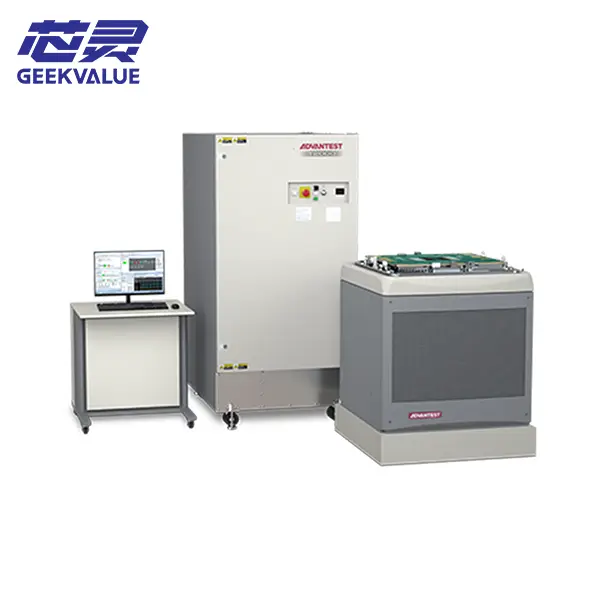
T2000 Platform Overview
| Item | Representative Capability |
|---|---|
| Equipment type | Modular semiconductor automatic test equipment |
| Primary applications | SoC, digital, mixed-signal, PMIC, automotive, industrial and CMOS image sensor testing |
| System architecture | Configurable modular platform |
| Mainframe scalability | From compact air-cooled configurations to large liquid-cooled systems |
| Test-head capacity | Approximately 13 to 52 instrument slots, configuration dependent |
| Maximum channel capacity | Up to approximately 8,192 channels |
| Digital performance | Available modules from 500 Mbps to 8 Gbps |
| Parallel testing | Multi-DUT capability based on device and module configuration |
| Development environment | Rapid Development Kit, simulator and debugging tools |
| Multi-user development | Up to eight users on supported configurations |
| Cooling | Air-cooled or liquid-cooled, depending on system |
| Production integration | Prober, handler and factory-interface integration, configuration dependent |
Flexible Modular Test Architecture
The T2000 is not a fixed-function semiconductor tester. Its capability is determined by the combination of modules installed in the system.
This modular structure allows a tester to be configured around the electrical characteristics of a specific semiconductor device instead of requiring every system to include the same instrument resources.
A T2000 configuration may contain combinations of:
High-density digital test modules
High-speed serial interface modules
Device power supply modules
Parametric measurement units
Arbitrary waveform generators
Waveform digitizers
High-voltage mixed-signal modules
Floating high-power resources
Cross-point matrix modules
CMOS image-capture modules
Application-specific interface hardware
Test-head and performance-board assemblies
This architecture helps semiconductor manufacturers balance test capability, channel density and capital investment.
A development system can be configured with only the resources required for device characterization. Additional modules and test capacity can then be added for qualification, pilot production or high-volume manufacturing.
Main Semiconductor Test Applications
| Device category | Typical test requirements |
|---|---|
| SoC devices | Digital functional test, scan, memory, power and mixed-signal measurement |
| Microcontrollers | Digital I/O, embedded memory, analog peripherals and device power |
| FPGA devices | High-density digital channels, scan patterns and interface testing |
| PMIC devices | Voltage, current, power sequencing and parametric measurement |
| Automotive ICs | High-voltage, high-current and mixed-signal testing |
| Industrial devices | Functional, power, analog and interface verification |
| ADC and DAC devices | DC parameters, linearity, waveform generation and digitization |
| Audio and video ICs | High-dynamic-range analog measurement |
| High-speed interface ICs | Serial and parallel interface testing |
| CMOS image sensors | Image capture, image processing, digital and analog measurement |
| Consumer semiconductor devices | Digital, power, analog and multi-domain functional testing |
SoC and Digital Device Testing
The Advantest T2000 can be configured for testing highly integrated system-on-chip devices containing digital logic, embedded memory, analog circuits, power-management functions and high-speed interfaces.
High-density digital modules provide the channel count required for devices such as:
Microprocessors
Microcontrollers
FPGAs
Consumer SoCs
Communication devices
Interface controllers
Digital signal-processing devices
Mixed-function integrated circuits
Available digital resources can support functions such as:
Functional pattern testing
Scan testing
Algorithmic pattern generation
Memory testing
Per-pin parametric measurement
Source-synchronous testing
Multiple timing domains
Serial interface testing
Parallel interface testing
High-density multi-site testing
The correct digital module must be selected according to the required data rate, pin count, timing accuracy and test-parallelism target.
Mixed-Signal and Analog Testing
Many modern semiconductor devices combine digital logic with analog functions. The T2000 can integrate waveform generation, digitization, voltage measurement and current measurement in the same test platform.
Depending on the installed modules, mixed-signal testing may include:
Analog waveform generation
Waveform digitization
Voltage generation
Current generation
Voltage measurement
Current measurement
ADC linearity testing
DAC linearity testing
Audio-frequency testing
Video-bandwidth measurement
Differential voltage measurement
Per-channel timing measurement
IDDQ testing
Static and dynamic device characterization
This allows manufacturers to test multiple functional blocks of a complex IC without transferring the device between separate test systems.
Power Management and Automotive Device Testing
The T2000 can be equipped with device power supply and high-power mixed-signal modules for testing power management and automotive semiconductor devices.
Potential applications include:
Communication PMICs
Consumer power management ICs
Automotive ASSPs
Battery-management devices
Power-control devices
Voltage regulators
Driver ICs
Industrial power devices
High-current semiconductor components
Mixed-voltage integrated circuits
Available instrument resources may provide:
Multiple device power channels
High-current supply capability
Floating voltage and current resources
Static and pulsed operation
Fast range switching
Voltage and current modulation
Simultaneous voltage and current measurement
Kelvin measurement
Parallel contact testing
High-voltage digital testing
Cross-point signal routing
The exact voltage, current and channel capability depends on the installed module set.
CMOS Image Sensor Testing
A suitably configured Advantest T2000 can be used for production testing of CMOS image sensors.
CMOS image sensors often contain image-sensing arrays together with digital logic, ADC, DAC, control circuits and high-speed output interfaces. The T2000 modular architecture allows the required digital, analog, device-power and image-capture functions to be combined in one test system.
Potential CMOS image sensor applications include devices used in:
Smartphones
Security cameras
Automotive cameras
Industrial cameras
Machine-vision equipment
Consumer imaging products
High-resolution camera systems
A current image-sensor configuration may support high-speed image capture for MIPI interfaces, dual-bank capture memory and dedicated image-processing resources.
Depending on the installed configuration, the system may provide:
MIPI D-PHY image capture
MIPI C-PHY image capture
Optional MIPI A-PHY support
High-speed serial image-data acquisition
Dual-bank image-capture memory
Dedicated image-processing engines
Concurrent data capture and processing
Multi-DUT image sensor testing
Digital and analog function testing
High-volume production capability
The image sensor test capability of a used T2000 must be verified from the installed capture modules, processing hardware, software and interface equipment.
Scalable System Configuration
The Advantest T2000 platform can be scaled for different stages of semiconductor product development.
| Production stage | Typical system objective | Configuration considerations |
|---|---|---|
| Engineering development | Initial test-program creation and device characterization | Compact mainframe and essential instrument modules |
| Device qualification | Expanded measurement coverage and reliability testing | Additional digital, analog, power or parametric resources |
| Pilot production | Repeatable testing with moderate parallelism | Production interface and multi-site capability |
| Medium-volume production | Improved throughput and lower test cost | Higher channel density and expanded test-head capacity |
| High-volume manufacturing | Maximum parallelism and production efficiency | Large mainframe, multiple modules and optimized DUT interface |
| Product-family support | Testing several related device types | Reusable software and flexible module allocation |
Compact configurations can help reduce initial investment for engineering or small-lot production.
Larger configurations can provide additional test-head slots, instrument channels and parallel test resources for mass production.
Multi-DUT Parallel Testing
Testing multiple devices simultaneously is an important method of reducing semiconductor test cost.
The T2000 uses high-density modules and multi-site control technology to support parallel testing. The number of devices that can be tested at the same time depends on:
Device pin count
Required digital channel count
Power supply requirements
Analog measurement resources
Interface-board design
Test-head configuration
Instrument-module quantity
Test-program structure
Handler or prober interface
Device-specific test time
Parallel testing is not determined by the tester model alone. The complete system configuration and test program must be designed around the target device.
A correctly configured multi-site system can help improve:
Production throughput
Tester utilization
Cost per tested device
Equipment-floor efficiency
Handler or prober productivity
Overall manufacturing capacity
Concurrent Test Capability
The T2000 can execute different test functions sequentially or concurrently, depending on the program and instrument resources.
Concurrent testing allows independent device functions to be measured at the same time rather than waiting for each test item to finish before starting the next.
Potential concurrent combinations may include:
Digital functional test and power measurement
Analog measurement and digital pattern execution
Multiple power-domain tests
Image capture and data processing
Parallel measurements across multiple DUT sites
Effective concurrent testing can reduce total test time, but it requires suitable instrument resources and properly developed test software.
Multi-User Test Development
Supported T2000 configurations use a multi-site CPU architecture that allows multiple engineers to access one test system and perform independent debugging work.
Up to eight users may be supported, depending on the system and software environment.
This can help engineering teams divide development work by device function, such as:
Digital test
Analog test
Device power
Memory test
Interface test
Image sensor test
Production optimization
Data analysis
Multiple engineers can develop or debug different sections of the test program without requiring a separate complete tester for each person.
This approach may help reduce engineering equipment requirements and shorten test-program development time.
T2000 Software and Development Environment
The T2000 software environment provides tools for test-program creation, debugging, simulation and production optimization.
Representative software functions may include:
Rapid Development Kit environment
Reusable test-code development
Offline system simulation
Pattern editing
Waveform visualization
Logic-analyzer functions
Oscilloscope-style tools
Shmoo analysis
Block-diagram tools
Test-condition optimization
Multi-user access
Production program execution
Test-result collection
Diagnostic and debugging tools
The software version and available licenses are important parts of the value of a used T2000 system.
Before purchase, buyers should confirm that the offered software supports the installed instruments and intended application.
Representative T2000 Instrument Modules
The following table shows representative T2000 module families. An individual tester may contain only some of these modules.
| Module | Module type | Representative function |
|---|---|---|
| 1.6GDME | High-density digital module | Up to 256 I/O channels and operation up to approximately 1.6 Gbps |
| 500MDM | Digital module | Up to 128 I/O channels and operation up to approximately 500 Mbps |
| 8GDM | High-speed digital module | Up to 96 I/O channels and operation up to approximately 8 Gbps |
| DPS32A | Device power supply | 32 channels with up to approximately 1 A per channel |
| DPS90A | Device power supply | 64-channel power resource with selectable current functions |
| DPS192A | High-density device power supply | 96 channels with different current-capability functions |
| DPS150AE | Enhanced high-current power supply | High-current device supply with parallel-operation capability |
| PMU32E | Parametric measurement unit | Voltage/current generation and measurement for DC and linearity testing |
| MMXHE | High-voltage mixed-signal module | Digital, PMU, AWG, digitizer and high-voltage measurement functions |
| MFHPE | Floating high-power module | Floating VI resources for power supply, load and dynamic measurement |
| MPCM | Cross-point matrix module | Flexible routing, Kelvin measurement and parallel contact testing |
| GPWGD | AWG and digitizer module | General-purpose analog waveform generation and measurement |
| 4.8GICAP | Image-capture module | High-speed CMOS image sensor capture for supported MIPI interfaces |
Module names and specifications can vary according to hardware generation and system revision.
Key Advantages of the Advantest T2000
Modular semiconductor test architecture
Configurable digital, analog, power and image-capture resources
Support for SoC and mixed-signal devices
Power management and automotive device test capability
CMOS image sensor test configurations
Compact engineering and high-volume production options
Air-cooled and liquid-cooled system configurations
High-density digital channels
Multi-DUT parallel testing
Concurrent test execution
Multi-user test development
Reusable software-development environment
Flexible test-program debugging tools
Expandable instrument capacity
Suitable for development, qualification and production
Can be integrated with compatible probers and handlers
Broad selection of instrument modules
Representative Technical Summary
| Specification item | Representative information |
|---|---|
| Platform type | Modular SoC semiconductor test system |
| System scale | Approximately 13 to 52 instrument slots |
| Maximum channel count | Up to approximately 8,192 channels |
| Cooling options | Air cooling or liquid cooling |
| Digital module speeds | Up to approximately 8 Gbps, module dependent |
| High-density digital channels | Up to 256 channels per selected digital module |
| Test applications | SoC, MCU, FPGA, PMIC, automotive, mixed-signal and CMOS image sensors |
| Multi-user capability | Up to eight users on supported systems |
| Parallel testing | Device- and configuration-dependent |
| Image sensor capture | Up to approximately 4.8 Gbps with supported modules |
| Factory use | Engineering, characterization, wafer test and final test applications |
| Software | RDK, simulator, debugging and optimization tools |
| External integration | Prober, handler and factory-interface dependent |
These specifications describe the T2000 platform and available module families. They do not represent the guaranteed configuration of every individual machine.
T2000 Configuration Is More Important Than the Model Name
Two Advantest T2000 systems may have significantly different testing capabilities even though they use the same platform name.
One machine may be configured for digital SoC testing, while another may be built for power management devices or CMOS image sensors.
The value and suitability of a used T2000 depend heavily on:
Mainframe type
Test-head type
Number of available slots
Cooling configuration
Installed instrument modules
Module quantities
Module revisions
Performance-board interface
Device-interface hardware
Software version
Software licenses
System calibration status
Included accessories
Original application
Buyers should request a complete hardware configuration list before evaluating the machine.
Used Advantest T2000 Purchase Checklist
| Inspection item | What should be confirmed |
|---|---|
| Mainframe | Model, slot quantity, cooling type and operating condition |
| Test head | Test-head model, slot count, interface condition and cable set |
| Installed modules | Exact module names, quantities, revisions and serial numbers |
| Software | Version, license status, development tools and application packages |
| Controller | Computer model, operating system, storage and communication interfaces |
| Calibration | Calibration date, records and expired items |
| Performance boards | Included boards, compatibility and physical condition |
| DUT interface | Load boards, probe interfaces, sockets and pogo assemblies |
| Cooling system | Air or liquid cooling condition, pumps, hoses and alarms |
| Power system | Power distribution, supply requirements and internal condition |
| Accessories | Cables, documentation, spare modules and maintenance tools |
| Operational status | Boot test, diagnostics, communication and module recognition |
| Production history | Previous application, device type and operating environment |
| Deinstallation | Whether the system was professionally shut down and disconnected |
| Packing | Test-head support, vibration protection and export packing |
| Installation | Facility requirements, rigging, startup and calibration scope |
What to Check Before Buying a Used T2000
Before purchasing a used or refurbished Advantest T2000, buyers should confirm the following information:
Equipment manufacturing year
Mainframe model
Test-head model
Air-cooled or liquid-cooled configuration
Number of instrument slots
Installed module list
Module quantities
Module serial numbers and revisions
Maximum available digital channels
Device power supply capability
Analog and mixed-signal resources
Image-capture capability
Performance-board interface
Included load boards
Included sockets or probe interfaces
System controller configuration
Operating-system version
T2000 software version
RDK availability
Software license status
Calibration records
Diagnostic results
Cooling-system condition
Power-on condition
Previous production application
Maintenance history
Included cables and accessories
Included manuals
Available spare modules
Current installation status
Deinstallation scope
Export-packing requirements
Installation and startup requirements
The complete system should be evaluated against the target device test plan before purchase.
Typical Applications
SoC Production Testing
The T2000 can combine digital, analog and device-power resources for testing complex system-on-chip devices.
Microcontroller and FPGA Testing
High-density digital modules can support functional, scan, memory and interface testing for microcontrollers and programmable logic devices.
PMIC Testing
Device power, parametric and high-power modules can be configured for voltage, current, sequencing and mixed-signal testing of power management ICs.
Automotive Semiconductor Testing
High-voltage and high-current resources allow the platform to support selected automotive and industrial semiconductor applications.
ADC and DAC Testing
Parametric measurement, waveform generation and digitization resources can be used for converter linearity and mixed-signal characterization.
CMOS Image Sensor Testing
Image-capture modules, digital channels, analog resources and image-processing hardware can be combined for CMOS image sensor testing.
Engineering and Device Characterization
Compact configurations can be used for test-program development, device debugging and characterization.
High-Volume Semiconductor Production
Expanded systems can support higher channel counts, multi-site testing and optimized production throughput.
Why Choose the Advantest T2000?
The Advantest T2000 is suitable for semiconductor manufacturers that require a configurable test platform rather than a single-purpose tester.
Its modular architecture allows instrument resources to be selected according to the target device. This can reduce unnecessary hardware investment while leaving room for future expansion.
For engineering teams, the software environment and multi-user architecture can support faster test-program development.
For production facilities, high-density instruments, concurrent testing and multi-site capability can help improve throughput and reduce cost per tested device.
The platform is particularly valuable when the installed hardware configuration closely matches the intended semiconductor application.
Frequently Asked Questions
What is the Advantest T2000?
The Advantest T2000 is a modular automatic semiconductor test system used for developing and executing electrical tests on SoCs, digital devices, mixed-signal ICs, power management devices and CMOS image sensors.
Is the T2000 only a digital tester?
No. The system can combine digital, analog, parametric, device-power, high-power and image-capture modules.
Which semiconductor devices can the T2000 test?
Depending on its configuration, it can test SoCs, microcontrollers, FPGAs, PMICs, automotive ICs, industrial devices, mixed-signal components and CMOS image sensors.
How many channels does the T2000 support?
Large configurations can provide up to approximately 8,192 channels. The actual channel count depends on the mainframe, test head and installed modules.
What is the difference between one T2000 system and another?
The main differences are the mainframe, test head, cooling type, installed instrument modules, channel count, software licenses and application-specific interface hardware.
Does the T2000 support high-speed digital testing?
Yes. Available digital modules include configurations operating from hundreds of megabits per second up to approximately 8 Gbps.
Can the T2000 test power management ICs?
Yes. A suitable configuration can include device power supplies, parametric measurement units, high-voltage mixed-signal resources and floating high-power modules.
Can the T2000 test CMOS image sensors?
Yes. A properly configured system can include high-speed image-capture modules and image-processing resources for CMOS image sensor applications.
Does the T2000 support parallel testing?
Yes. Multi-DUT parallel testing is supported, but the number of sites depends on the target device, instrument resources, interface design and test program.
Can several engineers use one T2000 system?
Supported configurations can allow up to eight engineers to access the tester and perform independent development or debugging tasks.
Is the T2000 suitable for wafer testing?
The platform can be integrated with a compatible wafer prober and probe-card interface. The required hardware depends on the wafer and application.
Can the T2000 be used for final package testing?
Yes. It can be connected to compatible semiconductor handlers and device-interface hardware for package-level production testing.
What should be checked before purchasing a used T2000?
Buyers should verify the complete module list, test-head configuration, cooling system, software licenses, calibration records, controller, interface hardware, operational condition and included accessories.
Are all T2000 modules compatible with every mainframe?
Compatibility can depend on the module generation, mainframe, test head, cooling configuration and software version. The complete system configuration should be checked before purchase.
Request Advantest T2000 Equipment Information
Looking for an Advantest T2000 semiconductor test system?
Send us your target device type, required digital speed, channel count, power requirements, analog resources, parallel test target and preferred system condition.
To identify a suitable configuration, please provide:
Target semiconductor device
Required test application
Digital pin count
Maximum digital data rate
Device power requirements
Analog measurement requirements
High-voltage or high-current requirements
Number of parallel DUT sites
Wafer-prober or handler model
Preferred module configuration
Installation country
Required delivery schedule
We can provide available equipment photos, installed module lists, condition information, configuration details and a quotation based on your project requirements.