Replace an Existing MRSI-605
A closely matched machine can help preserve existing production programs, fixtures, process knowledge and operator procedures after a major equipment failure.
The MRSI-605 AP is a legacy automated die bonding and advanced packaging platform developed for epoxy die attach, eutectic assembly, flip-chip bonding and precision assembly of microelectronic and optoelectronic devices. We help identify suitable used MRSI-605 equipment by process configuration, installed modules, condition and compatibility with the existing production requirement.
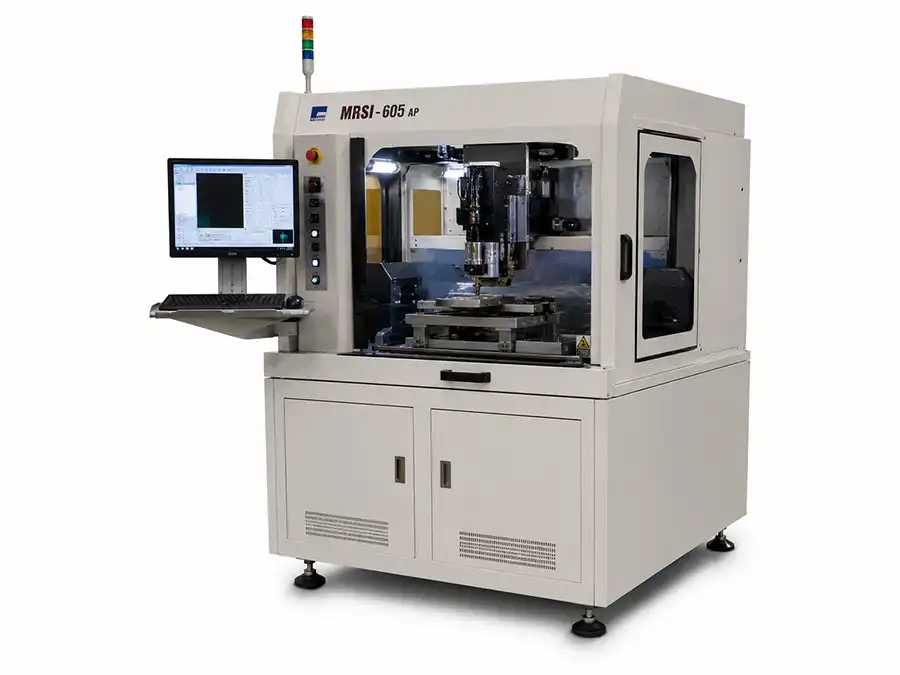
The MRSI-605 AP was introduced as an advanced packaging die bonder and ultra-precision automated assembly work cell. It was designed for high-speed, high-precision assembly of microelectronic and optoelectronic products rather than only laboratory positioning or manual prototype work.
Historical platform applications included microwave modules, optical modules, hybrid circuits, multi-chip modules, MEMS devices, photonics packages and advanced semiconductor packages. Depending on the installed configuration, the equipment could perform epoxy die attach, eutectic bonding and flip-chip assembly.
The equipment may appear in machine records under the names MRSI-605 AP, MRSI-605 or Newport MRSI-605. This naming difference is related to its production history and should not be used to determine the installed capability.
This page is positioned around used equipment sourcing, configuration verification, legacy process compatibility and technical recovery. For the documented 5 μm platform, visit the MRSI-705 die bonder page.
The page focuses on the requirements most likely to produce a qualified equipment inquiry rather than repeating generic MRSI die bonder information.
A closely matched machine can help preserve existing production programs, fixtures, process knowledge and operator procedures after a major equipment failure.
An additional compatible platform may reduce the engineering work required to introduce capacity for a mature product or long-term production program.
A complete MRSI-605 configuration may be useful when original tooling, heated stages, material handlers or application knowledge remain available.
Complete factory specifications are not available for every production year and configuration. The following information separates historically documented platform capabilities from functions that must be verified on the actual used machine.
| Item | Historically Documented Information | What Must Be Confirmed |
|---|---|---|
| Formal model name | MRSI-605 AP Advanced Packaging Die Bonder / Ultra-Precise Assembly Work Cell | Read the model plate, serial number, build year and original machine records. |
| Other market names | MRSI-605 and Newport MRSI-605 | Do not assume machines with different listing names have the same hardware. |
| Equipment function | Automated precision assembly of microelectronic and optoelectronic devices | Confirm whether the available system is complete and capable of automatic production. |
| Bonding processes | Epoxy die attach, eutectic bonding and flip-chip bonding were offered on historical configurations | Verify dispensers, flux or dipping hardware, heated stages, scrub, flip mechanism and software. |
| Placement accuracy | Historical Newport references describe 8 μm or 10 μm, depending on the platform record and application configuration | Request calibration data and run an acceptance test using the intended die and substrate. |
| Force control | Closed-loop placement-force control was a documented platform capability | Verify bond head, load cell, force range, calibration status and feedback performance. |
| Vision and lighting | Historical descriptions identify advanced machine vision and programmable lighting | Check cameras, optics, illumination, vision boards, pattern recognition and calibration. |
| Material presentation | Waffle pack, Gel-Pak, wafer and feeder presentation were available | Confirm exactly which stations, ejectors, holders and feeder bases are installed. |
| Production positioning | High-speed, high-precision automated assembly work cell | Throughput depends on the specific process, material input and machine configuration. |
| Application Group | Typical Products | Configuration Requirement |
|---|---|---|
| Photonics | Optical modules, laser packages, detectors and TO-style photonic assemblies | May require heated stages, rotation, special collets, gas control or dispensing. |
| Microwave and RF | MMICs, RF circuits, power devices and hybrid microwave modules | Requires appropriate vision, tooling, force control and substrate fixtures. |
| MEMS | Sensors and devices containing delicate internal or surface structures | Force control, pickup tooling and component support must be evaluated carefully. |
| Multi-chip modules | Assemblies containing several active and passive component types | Requires sufficient tool positions, material inputs and reliable program recovery. |
| Hybrid circuits | Microelectronic and optoelectronic hybrid packages | Process capability depends on adhesive, eutectic and fixture configuration. |
| Advanced packaging | Specialized semiconductor packages and flip-chip products | Confirm flip, flux, vision, force and substrate-handling modules. |
The difference reflects historical product records and application-specific configurations, not a specification that should be averaged or guaranteed.
A Newport corporate product description identified eight-micron placement accuracy, closed-loop placement-force control, advanced vision and lighting among the advanced features associated with the MRSI-605 AP platform.
A separate Newport technical announcement described 10-micron placement accuracy for an MRSI-605 configured for automated eutectic assembly of TO packages.
The MRSI-605 AP platform was introduced to support several advanced packaging processes, but the corresponding hardware is not present on every used machine.
Configured systems could support adhesive-based die placement for microwave modules, optical modules, hybrids, MEMS and multi-chip products. Verify dispensing or dipping hardware, material control and cure workflow.
Application-specific configurations supported direct eutectic and preform-based reflow processes. Heated stages, scrub control, cover gas and package tooling must be confirmed.
The MRSI-605 AP was promoted for flip-chip assembly as well as conventional die attach. Verify die inversion, flux handling, upward vision, substrate alignment and controlled placement capability.
Newport documented a specialized MRSI-605 configuration for automated eutectic assembly into transistor-outline packages. These functions must not be described as standard on every 605.
The documented configuration used automatic material handling with package clamping and rotation for die placement onto perpendicular surfaces.
The system supported direct gold-silicon eutectic assembly using controlled temperature, placement force and programmed scrub.
The documented option supported eutectic reflow using gold-tin or gold-germanium preforms for suitable photonics and high-reliability packages.
The application-specific stage used programmable closed-loop temperature control with a documented maximum of approximately 500°C.
An inverted-pyramid collet could place the die while applying programmable scrub to support eutectic reflow and oxide disruption.
The documented process used a heated hydrogen and nitrogen gas mixture over the hot plate to support the eutectic bonding environment.
Closed-loop force feedback supported the controlled handling of sensitive devices such as GaAs and InP components.
The equipment was positioned for automated assembly where component alignment, controlled placement and process flexibility were required.
Laser, detector, optical module and TO-package assembly using process-specific epoxy or eutectic configurations.
Placement of sensors and delicate components requiring controlled pickup and placement force.
MMIC, beam-lead, RF power and other high-frequency hybrid assemblies.
Precision assembly of RF components and semiconductor devices onto specialized substrates.
Products containing multiple die types, package materials and placement sequences.
Long-life high-reliability products where preservation of an established legacy process may be important.
A legacy die bonder should be evaluated according to completeness, process compatibility and recoverability. The machine price alone does not show the true project cost.
A detailed request reduces the risk of receiving quotations for incomplete or incompatible legacy machines.
Provide information from the existing production machine whenever possible.
Describe the intended product and process before requesting availability.
The models should be selected according to process requirements and production compatibility rather than model number alone.
| Selection Factor | MRSI-605 AP | MRSI-705 |
|---|---|---|
| Primary page intent | Legacy equipment sourcing, replacement and process compatibility | 5 μm platform specifications, configurable processes and equipment sourcing |
| Historical positioning | Ultra-precision automated assembly work cell for microelectronic and optoelectronic products | Configurable 5 μm high-precision die bonding platform |
| Published accuracy | Historical references cite 8 μm or 10 μm depending on configuration | Published placement accuracy of ±5 μm at 3 sigma |
| Published repeatability | Must be confirmed from machine-specific records and testing | Published placement repeatability of ±1.5 μm at 3 sigma |
| Best-fit requirement | Existing 605 programs, tooling, trained operators or validated legacy processes | Projects requiring documented 5 μm capability and broader configurable platform options |
| Configuration risk | High because of machine age, missing modules, old software and varied application builds | Still configuration-dependent, but platform documentation is more complete |
| Procurement priority | Completeness, compatibility, software recovery, tooling and inspection | Accuracy, process options, force control, material handling and production fit |
| Recommended choice | Select when compatibility with an existing MRSI-605 process creates a clear advantage | Select when the project requires the documented 5 μm MRSI-705 platform |
The objective is to establish what the machine actually includes before packing and shipment.
Confirm model, serial number, year, software, location and current operational status.
Check bond heads, vision, handlers, stages, dispensers, gas hardware and included tooling.
Review photographs, video, power-on tests, known faults, calibration and maintenance records.
Coordinate preparation, secure packing, transport, installation requirements and follow-up support.
Send the existing machine information or the intended process. A detailed request allows the equipment configuration and recovery requirements to be checked before quotation.
Please provide the existing machine details or intended bonding process.