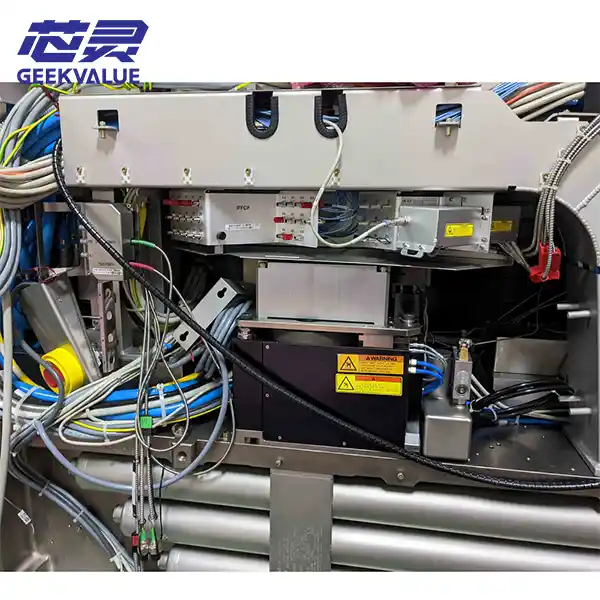
 The ASML XT 760F is an 8-inch (200mm) wafer i-line step-and-scan lithography system from the Dutch company ASML. It is a classic, mainstay model within the XT platform, specifically designed for thick-resist applications and power device manufacturing. It serves as a complementary partner to the XT 1250i (KrF) model—while the 760F handles thick-resist layers and coarser features, the 1250i manages fine, critical layers.
Below is a comprehensive overview of the system:
1. Key Technical Specifications
Light Source: Uses a high-pressure mercury lamp (i-line) with a 365nm wavelength, rather than a laser.
Optical Performance: The projection objective has a typical numerical aperture (NA) of 0.65, with a resolution limit of approximately 220nm–250nm.
Exposure Field: Standard field size is 26mm x 33mm; throughput is approximately 80–100 wafers per hour (WPH), depending on photoresist thickness.
Overlay Accuracy: Equipped with the XT platform's standard alignment system, the overlay accuracy is typically around ±40nm—sufficient for non-critical layers and thick-resist processes.
2. Technical Features and Platform Advantages (Compared to the older PAS 5500/700)
XT Platform Upgrades: Compared to the legacy PAS 5500/700 series, the 760F offers significantly improved stage rigidity and scanning acceleration. The transition between measurement and exposure is smoother, and overall system stability surpasses that of the previous generation.
"King" of Thick-Resist Processes: The longer wavelength of the i-line source provides excellent penetration depth for thick photoresists (typically 3µm–10µm). Combined with optimized illumination uniformity, it ensures steep, vertical sidewall profiles—a feat difficult to achieve with KrF (248nm) systems.
Illumination Modes: Supports standard conventional illumination and annular illumination, making it suitable for patterning wafers with significant surface topography (high aspect ratios). 3. Primary Application Segments (Strict Division of Labor with KrF Models)
Rather than pursuing fine linewidths, it specializes in high-reliability, high-thickness "coarse-feature" processes:
Thick photoresist layers for power semiconductors: Deep trench etch masks for IGBT, MOSFET, and SiC (silicon carbide) devices (requiring the application of extremely thick photoresist);
MEMS microstructures: Cavity or pillar structures for accelerometers and microfluidic chips;
Non-critical layers: Passivation layer openings, coarse metal routing layers (Al/Cu), ion implantation layers, etc.
4. Production Line Division of Labor with XT 1250i (KrF) (Crucial)
If your 8-inch production line operates both pieces of equipment:
760F (i-line): Dedicated to layers requiring photoresist thickness > 2.5µm (e.g., deep trenches, thick metal), fully leveraging its penetration capability;
1250i (KrF): Dedicated to fine-feature layers requiring photoresist thickness < 1.5µm (e.g., active areas, contact holes).
Avoid using KrF for thick resist exposure (which causes bottom residue and pattern collapse) and avoid using i-line for fine linewidths (due to insufficient resolution); a rational division of labor is the core strategy for maintaining stable yields.
6. Operational Pain Points and Critical Warnings (Practical Advice for Engineers)
Mercury lamps are "power-hungry beasts": They generate immense heat, making the associated water-cooling system (chiller) a lifeline. If exposure energy is insufficient, do not simply replace the lamp; first check the cooling water flow rate and filters. Poor heat dissipation causes premature lamp aging, and 80% of energy-related alarms stem from water circuit blockages.
Static electricity and dust are invisible killers: i-line systems are more sensitive to microscopic dust on lenses than KrF systems; maintaining cleanroom standards (Class 1/10) and high-purity nitrogen purge gas is essential. During routine maintenance, abnormal flow rates in the lens barrel purge system can directly cause image blurring—an issue far more insidious than lamp aging. In short: The XT 760F is an irreplaceable "heavy lifter" for thick-resist processes on 8-inch production lines. Amid the current boom in power devices like SiC and IGBTs, it serves as the perfect complement to your existing KrF systems (such as the XT 1250i) rather than a piece of obsolete equipment. When purchasing, lens transmittance is the critical factor determining its viability—do not base your decision solely on price.