The ASM AD830 Plus and ASMPT AD838L-Plus are both automatic die bonding machines, but they should not be treated as interchangeable platforms. The AD830 Plus is often selected for established high-throughput die attach production, particularly where the factory already has compatible package files, lead-frame tooling, wafer handling and silver-epoxy processes. The AD838L-Plus provides a different material-handling direction, including dragging-free indexing, extra-large substrate support and optional higher-precision bonding capability.
For a factory planning capacity expansion, machine replacement or a new semiconductor package, the correct question is not simply which model is newer. The practical question is:
Which machine can process the actual wafer, die, epoxy, lead frame or substrate with the required accuracy, output, tooling and automation?
This comparison explains the main differences between the ASM AD830 Plus and AD838L-Plus, the production conditions that favor each model, the configuration risks that must be checked and the information required before selecting a used or serviced machine.
Important: Published machine performance is package- and material-dependent. Used machines with the same model name may also have different wafer loaders, epoxy modules, bond heads, optics, software, material-handling systems and tooling. The exact offered machine must be checked before a purchase decision.
Quick Answer: AD830 Plus or AD838L-Plus?
The ASM AD830 Plus is usually the more practical direction when a factory already operates the AD830 platform, uses a compatible wafer-to-lead-frame die attach process and wants to add capacity without completely redesigning its production method.
The ASMPT AD838L-Plus deserves stronger consideration when the project requires extra-large substrate handling, dragging-free indexing for sensitive materials, a higher-precision placement option or a more automated material-handling arrangement.
The following summary provides a starting point:
| Production Requirement | Likely Direction | Reason |
|---|---|---|
| Replace an existing AD830 Plus | AD830 Plus | Existing tools, recipes, operators and maintenance experience may be easier to retain. |
| Add capacity to an established AD830 line | AD830 Plus | The same machine family may reduce process redevelopment and training requirements. |
| Process large or sensitive substrates | AD838L-Plus | The AD838L series emphasizes dragging-free indexing and large substrate handling. |
| Require an optional higher-precision bonding configuration | AD838L-Plus | A high-precision option is available, subject to the actual machine configuration and package. |
| Use dual stamping or dot-dispensing silver-epoxy stations | AD830 Plus | The AD830 Plus platform emphasizes high-speed dual stamping or dot dispensing. |
| Need automatic material handling and optional automatic wafer loading | AD838L-Plus | The platform supports factory-automation-oriented handling options. |
| Need to transfer existing AD830 package files and tooling | AD830 Plus first | Compatibility may be easier, although every configuration still requires verification. |
| Develop a new package with no existing machine restriction | Compare both | Selection should be based on the actual material flow, accuracy, process and total project cost. |
ASM AD830 Plus Overview
The ASM AD830 Plus is an automatic die bonder developed for high-throughput semiconductor die attach. Its machine architecture combines wafer positioning, die recognition, die pickup, epoxy application, lead-frame handling, programmed die placement and optical inspection.
Official ASMPT information highlights several important AD830 Plus design directions:
High-speed bonding of up to 22,000 UPH under specified package and material conditions
Double decoupled linear-motor bond-head design
Dual stamping or dot-dispensing epoxy capability
Rotary collet bond-arm system
Automatic theta correction during the pick-and-place process
New stamping-arm and magnetic-anvil designs for faster conversion
Static bond optics designed for simpler maintenance
Pre-bond and post-bond inspection performed within the bonding cycle
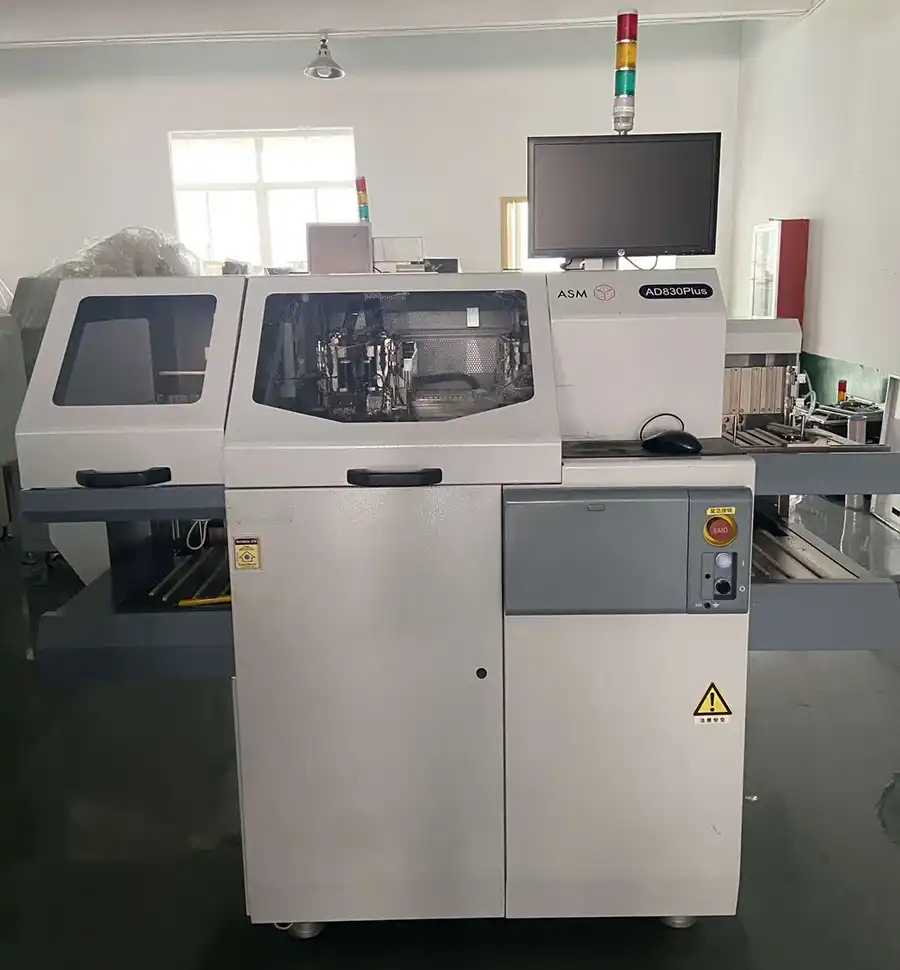
These features make the AD830 Plus especially relevant to manufacturers that value throughput, established package support and continuity with an existing ASM die bonding process.
However, the AD830 Plus model name does not confirm the complete machine. A used unit may be fitted with different:
Lead-frame input loaders
Output magazine elevators
Wafer tables and automatic wafer loaders
Silver-epoxy dispensing or stamping modules
Left and right epoxy-processing stations
Cameras, lenses and lighting systems
Bond-head components
Software versions and package files
Collets, ejector tools, anvils and clamps
For current machine availability, condition and inspection support, review theused ASM AD830 Plus die bonder.
ASMPT AD838L-Plus Overview
The ASMPT AD838L-Plus is also an automatic die bonder, but its strongest differentiators are related to material handling, large substrate capability, precision options and factory automation.
The official platform description emphasizes:
Dragging-free indexing for material handling
An advanced patented bond-head design for high output
Extra-large substrate handling up to 300 mm × 100 mm
An optional high-precision bonding configuration
XY placement accuracy of up to ±15 μm at 3σ with the applicable option and conditions
Automatic material handling
Optional automatic wafer loading
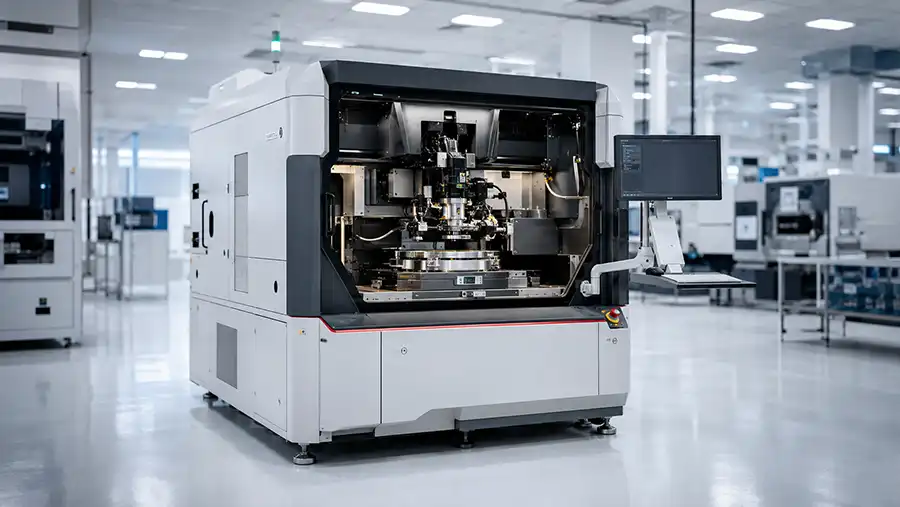
Dragging-free indexing can be particularly relevant when the substrate, panel or carrier is fragile, easily scratched or sensitive to conventional transport contact. The large-format handling capability also opens applications that may not fit the transport architecture of an older die bonder.
It is important to distinguish the AD838L-Plus from other machines in the AD838 family. AD838, AD838L, AD838L-Plus and AD838L-G2 should not automatically be assumed to have identical precision, flip-chip functionality, optics, handling modules or automation options.
For available equipment information, review theASMPT AD838L-Plus die bonder.
Detailed AD830 Plus vs AD838L-Plus Comparison
| Comparison Area | ASM AD830 Plus | ASMPT AD838L-Plus | Selection Impact |
|---|---|---|---|
| Primary Direction | High-throughput automatic die attach | Automatic die bonding with enhanced material handling and precision options | Choose based on the actual package and process rather than model age. |
| Material Transport | Configured lead-frame or substrate transport system | AD838L-series dragging-free indexing | Sensitive or scratch-prone materials may benefit from the AD838L handling direction. |
| Substrate Size | Depends on the installed work holder and transport configuration | Extra-large substrate handling up to 300 × 100 mm | Large panels or substrates should be checked against physical transport limits. |
| Throughput Direction | Up to 22,000 UPH under specified conditions | Advanced bond-head design for high UPH | Do not compare headline output alone; test the complete package cycle. |
| Epoxy Process | Dual stamping or dot dispensing emphasized | Confirm the installed adhesive or process-material module | The offered machine must include the correct dispensing or material-application hardware. |
| Precision | Confirm using the actual machine, package and acceptance test | Optional precision configuration up to ±15 μm at 3σ | Required accuracy must be defined before the model is selected. |
| Wafer Loading | Manual or automatic arrangement depending on configuration | Automatic wafer loader available as an option | Check wafer size, frame, cassette and loading sequence. |
| Changeover | Fast-conversion design with stamping arm and magnetic anvil | Depends on product fixtures, material handling and tools | Compare real package changeover time rather than only bond-cycle time. |
| Existing Tool Compatibility | May align more closely with an existing AD830 production line | Usually requires a complete tooling review | Existing collets and fixtures should never be assumed to fit without measurement. |
| Best Procurement Scenario | Replacement, capacity expansion or continuity of an existing AD830 process | New package introduction, larger substrate projects or automation upgrades | The lowest machine price is not always the lowest total project cost. |
When the AD830 Plus Is Usually the Better Choice
1. Your Factory Already Operates AD830 Plus Machines
An existing installed base is one of the strongest reasons to continue using the AD830 Plus platform. Operators may already understand the user interface, maintenance teams may already know the common wear areas and the factory may have compatible spare parts and tools.
The potential benefits include:
Shorter operator training
More familiar maintenance procedures
Possible reuse of tooling and consumables
Existing spare-parts knowledge
Easier comparison with current production parameters
Reduced risk when replacing a failed machine
This does not mean any AD830 Plus can be installed as a direct replacement. The source and replacement machines must still be compared by wafer handling, lead-frame input, epoxy module, work holder, optics, software and tools.
2. You Need to Add Capacity Without Redesigning the Process
When the existing package is stable and the factory only needs more output, changing to a completely different die bonder may introduce unnecessary qualification work.
A matching AD830 Plus can allow the engineering team to focus on machine-to-machine correlation instead of developing a new production architecture. This is particularly valuable when:
The current package has already passed reliability qualification
The existing process window is well understood
Production downtime must be minimized
Customer approval would be required for major equipment changes
Existing tools and fixtures represent a significant investment
3. The Product Uses an Established Silver-Epoxy Process
The AD830 Plus is closely associated with automatic silver-epoxy die attach. Its stamping and dot-dispensing direction makes it suitable for production environments where adhesive deposition, die pickup and die placement have already been optimized around the platform.
The equipment still needs to be matched to:
Epoxy type and viscosity
Working time and storage condition
Dispensing needle or stamping-tool dimensions
Deposit size and shape
Required bond-line thickness
Die dimensions and thickness
Lead-frame surface and bond-pad design
4. Fast Replacement Is More Important Than Platform Modernization
When a production machine has failed and customer deliveries are at risk, the most practical objective may be to restore capacity quickly. In this case, a closely matched AD830 Plus can be a lower-risk solution than introducing a different machine family.
For replacement projects, prepare:
Original machine nameplate
Full configuration photographs
Wafer-loader information
Lead-frame and magazine drawings
Epoxy-module photographs
Software version
Package-file backups
Tooling photographs and part numbers
Utility requirements
For a deeper process and replacement checklist, read theASM AD830 die bonder process and setup guide.
When the AD838L-Plus May Be the Better Choice
1. The Substrate Is Large, Fragile or Easily Scratched
The AD838L-Plus emphasizes dragging-free material indexing and large substrate handling. This can be important when conventional contact or dragging creates scratches, particles, alignment variation or damage.
Before choosing the machine, confirm:
Maximum substrate length and width
Substrate thickness
Panel flatness or warpage
Surface sensitivity
Carrier or fixture requirement
Input and output orientation
Support points during transport
Available edge-clearance area
2. The Project Requires an Optional Higher-Precision Configuration
The AD838L-Plus offers a high-precision bonding option, but the published option should not be confused with guaranteed production accuracy for every product. The final result depends on die dimensions, substrate behavior, optics, tooling, environmental control and the selected process.
A precision requirement should be written in measurable terms:
XY placement tolerance
Die-rotation tolerance
Measurement method
Sample quantity
Process capability requirement
Inspection-system repeatability
Temperature and environmental conditions
3. The Factory Wants More Automatic Material Handling
The AD838L-Plus supports automation-oriented material handling and an optional automatic wafer loader. This may reduce operator intervention and support a more integrated production concept.
However, automatic loading only creates value when the complete material flow is compatible. Review:
Wafer size and frame format
Wafer cassette dimensions
Substrate or carrier input
Barcode or identification requirements
Reject-material handling
Output buffer capacity
Upstream and downstream equipment interfaces
4. The New Product Is Not Restricted by Existing AD830 Tooling
A completely new package creates an opportunity to select the most suitable platform instead of forcing the product into an existing machine architecture. When no qualified AD830 process needs to be preserved, the AD838L-Plus may provide greater flexibility for large substrates, sensitive materials and automation.
Can the AD838L-Plus Directly Replace an AD830 Plus?
In most projects, the answer is not without a complete engineering review.
Even when both machines can perform automatic die attach, they may differ in:
Machine footprint
Electrical and pneumatic utilities
Wafer input and frame format
Lead-frame or substrate transport
Magazine and carrier dimensions
Epoxy-processing hardware
Bond-head and pickup-tool design
Ejector configuration
Vision references and illumination
Package-file format
Tooling dimensions
Downstream curing and wire-bonding compatibility
A direct replacement requires more than demonstrating that the AD838L-Plus can place a die. The complete process must produce acceptable adhesive deposits, stable pickup, correct placement, repeatable inspection and reliable material transfer.
Can AD830 Plus Tooling Be Reused on an AD838L-Plus?
Some tooling concepts may appear similar, but compatibility must never be assumed. A collet that fits the die may not fit the new bond arm. An ejector pin may have the correct diameter but an incompatible length, mounting design or operating range.
Review every production tool individually:
| Tool | Key Measurements | Compatibility Risk |
|---|---|---|
| Collet | Die pocket, vacuum opening, overall length, mounting interface | Incorrect fit can cause die movement, vacuum loss or collision. |
| Ejector Pin | Tip shape, diameter, length, mounting and travel | Incorrect geometry can damage the die or prevent release. |
| Ejector Cap | Opening, support area, height and mounting | Poor support may create wafer-tape deformation. |
| Anvil | Package support, reference position, magnetic mounting | Incorrect support can affect die placement and epoxy spread. |
| Window Clamp | Opening size, lead-frame clearance and clamp force | Mechanical interference may damage the frame or block transport. |
| Epoxy Tool | Needle or stamp dimensions, holder and process height | Incorrect tools change deposit volume, shape and position. |
| Magazine | Width, depth, slot pitch, reference surfaces | Incompatible magazines can stop input or output transfer. |
How to Compare Throughput Correctly
Published UPH figures are useful for initial screening, but they should not be used as the only purchasing criterion. Actual output includes much more than the bond-head movement.
The complete production cycle may include:
Loading the lead frame or substrate
Indexing material into the process position
Applying epoxy or another die-attach material
Searching the wafer and selected die
Separating the die from wafer tape
Picking and rotating the die
Recognizing the target position
Placing the die
Completing pre-bond or post-bond inspection
Moving to the next bonding location
Unloading the completed material
Production output is also affected by:
Number of dies per frame or substrate
Distance between wafer pickup and bonding locations
Epoxy-deposition sequence
Vision-search time
Die size and wafer-map arrangement
Inspection requirements
Material-loading interruptions
Alarm frequency
Tool cleaning and epoxy replacement
Product changeover
The best comparison is a sample production test using representative material and an agreed recipe.
Total Project Cost: More Than the Machine Price
A lower purchase price does not always produce a lower project cost. Engineering and procurement teams should compare the complete cost of putting the machine into stable production.
| Cost Area | Questions to Ask |
|---|---|
| Machine Purchase | What condition, configuration, accessories and documents are included? |
| Inspection and Service | Does the machine need cleaning, calibration, repair or component replacement? |
| Tooling | Can existing tools be reused, or must new collets, ejectors, anvils and fixtures be produced? |
| Process Development | How much engineering time is required to establish epoxy, pickup, placement and inspection settings? |
| Installation | Are site preparation, rigging, utilities and engineer travel required? |
| Training | Are operators and maintenance engineers already familiar with the platform? |
| Qualification | Will changing the equipment model require customer or reliability requalification? |
| Production Downtime | How long can the factory wait before the machine reaches qualified output? |
| Spare Parts | Are critical motors, sensors, cameras, drivers, boards and mechanical parts available? |
| Future Flexibility | Can the selected configuration support planned products and substrate formats? |
Used AD830 Plus vs Used AD838L-Plus: What Must Be Inspected?
A used machine should not be approved based only on exterior photographs, a power-on video or the model label. Inspection should confirm that the offered machine can perform the required production sequence.
Machine Identity
Manufacturer and exact model
Serial number
Manufacturing year
Electrical specification
Software version
Option and module list
Mechanical System
Bond-head movement
Axis homing and repeatability
Abnormal noise or vibration
Signs of previous collision
Wafer-table movement
Ejector condition
Track or substrate indexing
Vision System
Camera image quality
Lens and lighting condition
Focus stability
Pattern-recognition repeatability
Pre-bond inspection
Post-bond inspection
Uplook optics when required
Process Modules
Epoxy-dispensing or stamping station
Material-level sensors
Syringe or tool holders
Wafer loader
Input and output handling
Substrate carriers or magazines
Production Test
Where possible, complete the factory acceptance test with representative:
Wafer
Die
Wafer frame
Lead frame or substrate
Carrier or magazine
Collet and ejector tools
Epoxy or process material
AD830 Plus vs AD838L-Plus Selection Worksheet
Complete the following information before requesting a machine recommendation:
| Required Information | Project Data |
|---|---|
| Current machine model | |
| Reason for purchase | Replacement / expansion / new package / backup machine |
| Die length and width | |
| Die thickness | |
| Wafer diameter | |
| Wafer-frame format | |
| Lead-frame or substrate dimensions | |
| Material sensitivity | Standard / fragile / scratch-sensitive / warped |
| Die-attach material | |
| Dispensing or stamping process | |
| Required XY placement accuracy | |
| Required rotation accuracy | |
| Target production output | |
| Inspection requirements | |
| Existing tools and package files | |
| Automatic wafer loading required | Yes / No |
| Destination country |
Final Recommendation
Choose the ASM AD830 Plus when production continuity, existing process compatibility, established silver-epoxy die attach and faster replacement are the main priorities.
Choose the ASMPT AD838L-Plus when the project requires larger or more sensitive substrates, dragging-free indexing, optional higher-precision bonding or a stronger factory-automation direction.
Do not select either machine from a general model description alone. The final decision should be based on:
The actual offered machine configuration
The real wafer and substrate format
The die-attach process
The required tools
The production acceptance standard
The cost and risk of qualification
Compare an AD830 Plus and AD838L-Plus for Your Production Line
Send us your die dimensions, wafer format, lead-frame or substrate drawing, die-attach material, target output and required accuracy. If you already operate an AD830 Plus, also send the machine nameplate, installed-module photographs and tooling information.
We can help compare available ASM die bonder configurations, review production compatibility and prepare an equipment inspection plan.
Frequently Asked Questions
Is the AD838L-Plus a direct replacement for the AD830 Plus?
Not automatically. The two machines may use different material-handling systems, substrate fixtures, wafer-loading arrangements, process modules, optics, software and tooling. A direct replacement decision requires a configuration comparison and representative sample test.
Which machine is better for an existing AD830 production line?
A closely matched AD830 Plus is usually the lower-risk starting point when the factory wants to preserve existing package files, tools, operator experience and maintenance procedures. The offered replacement still needs to be compared with the current machine.
Which machine can handle larger substrates?
The AD838L-Plus officially supports extra-large substrate handling up to 300 mm × 100 mm, subject to the applicable configuration and material. Actual substrate thickness, flatness, carrier and transport clearance must also be confirmed.
Which machine offers higher placement precision?
The AD838L-Plus offers an optional high-precision bonding configuration specified at up to ±15 μm at 3σ XY placement accuracy under applicable conditions. Production accuracy must still be validated using the actual die, substrate, optics, tooling and process.
Can AD830 Plus tools be used on an AD838L-Plus?
Do not assume compatibility. Collets, ejector pins, ejector caps, anvils, clamps, magazines and epoxy tools must be compared by dimensions, mounting interface and operating requirements.
Is the AD830 Plus still suitable for high-volume production?
The AD830 Plus remains relevant where its process, material handling and output fit the production package. ASMPT publishes bonding performance of up to 22,000 UPH under specified package and material conditions, but real output must be evaluated using the complete production cycle.
Does the AD838L-Plus support flip-chip bonding?
Flip-chip capability should be confirmed against the exact AD838L variant and installed machine configuration. The AD838L-Plus and AD838L-G2 should not be treated as identical models. Request the nameplate, option list and functional demonstration before assuming flip-chip support.
What information is required before requesting a quotation?
Provide the required model or current machine, die dimensions, die thickness, wafer size, wafer frame, substrate or lead-frame drawing, attachment material, accuracy requirement, target output, inspection requirement, existing tooling and destination country.
Should a used die bonder be tested with production material?
Yes, whenever representative material and tools are available. A dry cycle can confirm basic motion but cannot fully evaluate die release, vacuum pickup, epoxy behavior, substrate handling, placement quality and inspection stability.