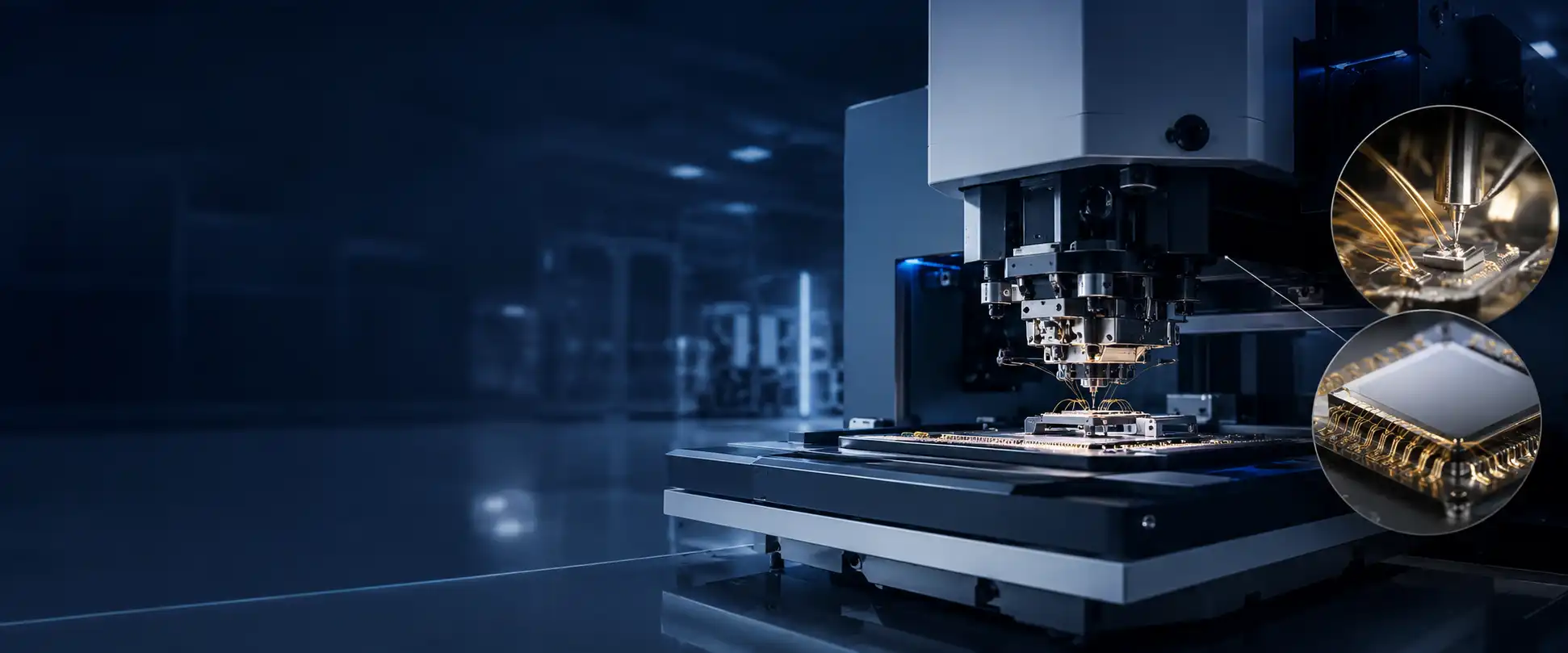
Incoming Die Presentation
Confirm whether the die arrives on a wafer frame, tray, Gel-Pak, waffle pack or another carrier. This affects the loader, wafer table, ejector, pickup method and software sequence.
Choose a die bonder by matching six production requirements: die presentation, attach process, substrate handling, placement requirements, target throughput and downstream handoff. This guide turns those requirements into a practical machine shortlist.
Confirm these six production requirements before comparing machine models or requesting a shortlist. Each factor changes the handling, process modules, control platform or automation level the project may require.
| Selection Factor | Confirm for Your Project | How It Affects Machine Selection |
|---|---|---|
01Die input format | Wafer frame, tray, Gel-Pak, waffle pack or carrier | Determines the loader, ejector, pickup tooling and software flow. |
02Attach process | Epoxy, eutectic, soft solder or flip chip | Determines dispensing, heating, force, atmosphere and material modules. |
03Substrate handling | Leadframe, ceramic, PCB, strip, boat or carrier | Determines transport, workholder, tooling and indexing. |
04Placement requirement | Die size, alignment marks, pitch, tolerance and repeatability | Determines motion, vision and calibration requirements. |
05Output and product mix | Target UPH, batch size, product variety and changeover frequency | Determines automation level, handling strategy and recipe flexibility. |
06Downstream handoff | Cure, reflow, inspection, wire bonding or unloading | Determines output handling and production-line integration. |
Once these six requirements are defined, compare equipment as candidate platforms. Final suitability still depends on the configuration, tooling, software, condition and delivery scope of the actual machine being offered.
Headline accuracy does not prove line fit. The equipment must accept the die correctly, run the intended attach process and transfer the bonded assembly into the next operation without creating a handling or cycle-time bottleneck.
Confirm whether the die arrives on a wafer frame, tray, Gel-Pak, waffle pack or another carrier. This affects the loader, wafer table, ejector, pickup method and software sequence.
Confirm material delivery, heating, force, alignment, atmosphere and process control. A platform family may support several routes, while one actual machine carries a specific installed process package.
Confirm substrate or leadframe transport, indexing, unloading and the next operation, such as cure, reflow, inspection or wire bonding. These details determine whether the machine fits the wider production flow.
The best machine is not always the platform with the highest nominal speed or the tightest advertised accuracy. The shortlist should follow the production priority that cannot be compromised.
Small die, tight pitch, difficult alignment marks or strict rotation tolerance increase the value of stable optics, motion control and repeatability.
Loading, indexing, inspection and unloading can limit real production output even when the bond-head cycle appears fast.
High-mix and NPI work may benefit more from practical format changes and reusable tooling than from maximum nominal UPH.
Replacement projects should compare floor space, power, air, exhaust, data connections and the equipment immediately before and after die bonding.
A useful quotation request should describe the product and production flow, not only a preferred brand or model.
Material, dimensions, thickness, wafer size, street condition and incoming presentation.
Epoxy, eutectic, solder, sintering, thermocompression or another required route.
Leadframe, ceramic, PCB, strip, carrier, workholder and package dimensions.
Alignment marks, tolerance, repeatability, inspection and post-bond requirements.
Required UPH, product mix, batch size, changeover frequency and automation level.
Footprint, utilities, upstream input, downstream handoff and destination country.
Use these equipment pages as starting points after defining the six selection requirements. A linked model is not automatically suitable for the project; the actual unit and installed configuration still need to be verified.
Review this automatic platform for wafer-to-leadframe silver-epoxy die attach where integrated loading, bonding, inspection and unloading are relevant to the production flow.
View ASM AD830 PlusReview this platform when the project needs a broader process range, configurable handling or a practical balance between production output and product-mix flexibility.
View ASMPT AD832iReview this platform for flexible semiconductor and microelectronic assembly where the required process, tooling, placement control and product format must be compared together.
View Datacon 2200 EVONeed a broader comparison? The main Die Bonder category contains current model-level pages. Use the Flip Chip category when the project requires face-down interconnect or bump alignment, and use the process guide when the attach route is not yet defined.
Browse All Die BondersThese answers focus on building a shortlist. Final approval should be based on the actual machine configuration and the project requirements.
Share the six selection factors, preferred machine condition and destination. The review should identify suitable equipment directions, current models worth comparing and the configuration or line-interface questions that still need confirmation.